
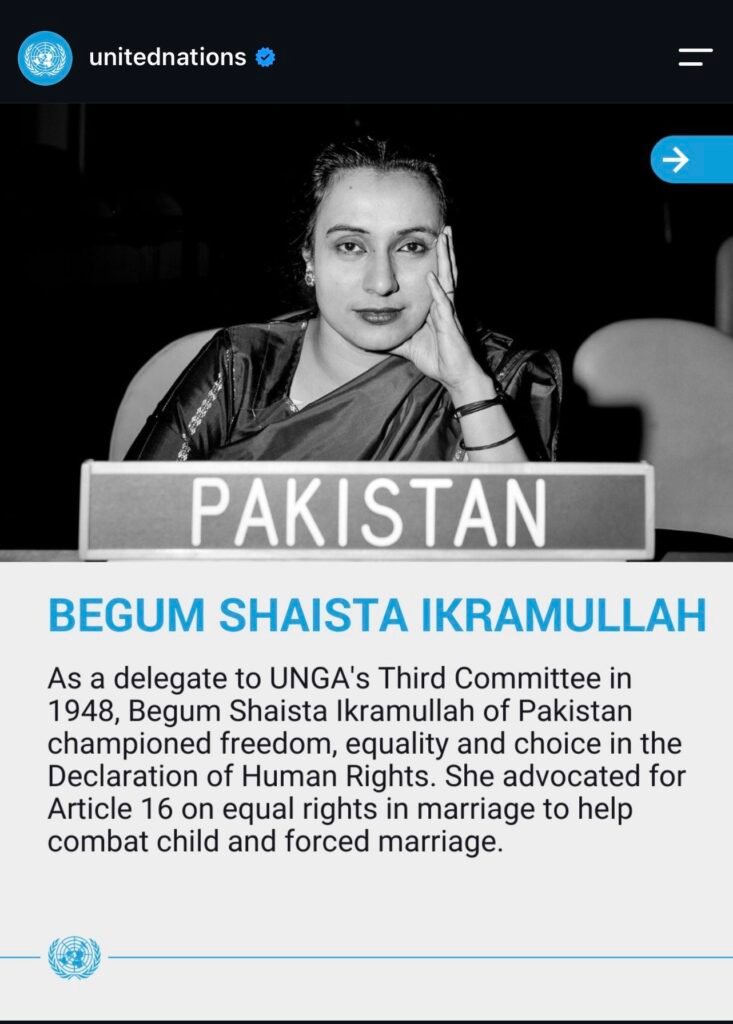
I am an MPhil scholar in Gender Studies. I have read Wollstonecraft and de Beauvoir, bell hooks and Judith Butler. I can trace the so-called “waves” of Western feminism in my sleep. And yet, until a few weeks ago, I did not know the name Begum Shaista Ikramullah.
I found out about her the way most of us find out about anything now: a social media post. The United Nations marked International Day of Women in Diplomacy by honouring the women who helped draft the Universal Declaration of Human Rights, more than 77 years ago. One name on that list was Pakistani. I had never encountered her in a classroom, a syllabus, or a textbook in seven years of studying gender. So I went looking for her myself.
What I found should embarrass every gender studies curriculum that calls itself global.
Who was she?
Begum Shaista Ikramullah was Pakistan’s first female civil servant and the first Muslim woman to earn a PhD from the University of London. She was one of only two women in Pakistan’s first Constituent Assembly. In 1948, she sat as a delegate to the UN General Assembly’s Third Committee, representing Pakistan in the drafting of the Universal Declaration of Human Rights, championing freedom, equality, and choice in its language.
She specifically advocated for Article 16, the article on equal rights in marriage, understanding decades before “child marriage” and “forced marriage” became standard vocabulary in development reports that legal equality in the home was the foundation everything else depended on. She was not a footnote in that room. She was one of the women who shaped the document the entire modern human rights framework still stands on.
She went on to become Pakistan’s first female diplomat and its ambassador to Morocco. She wrote From Purdah to Parliament, a memoir charting her own journey from a secluded upbringing to the world stage, and Letters to Neena, work that helped preserve Urdu literary tradition. She died in 2000, and was posthumously awarded the Nishan-i-Imtiaz, Pakistan’s highest civilian honour, in 2002.
This is not an obscure figure. This is a woman with a UN paper trail, a portrait now hanging in the Palais Wilson in Geneva, and a direct hand in one of the most consequential documents of the twentieth century. And an MPhil scholar in her own country, in her own field, had never heard of her.
The problem isn’t that we lack women leaders. It’s that we lack the will to teach them.
This is the part that needs saying plainly: when gender studies as a discipline gets taught primarily through a Western canon, the message students absorb, often without anyone intending it, is that feminism is something that happened to other countries first, and arrived in the rest of the world later as an import. That women’s rights are a Euro-American invention that the Global South is still catching up to.
Begum Shaista Ikramullah’s story breaks that narrative completely. She was not catching up. In 1948, she was in the room, in real time, shaping the legal language that would define rights protections worldwide for the next century. Pakistan was three years old. And a Pakistani woman was already negotiating what equality inside a marriage should legally mean, on a global stage, while many Western nations had not yet extended full legal personhood to married women in their own domestic law.
She is not alone. South Asia, the Middle East, Africa, and Southeast Asia are full of women like her: organizers, legislators, scholars, and revolutionaries whose work simply never made it into the reading lists that define how “feminism” gets taught. Not because their contributions were smaller. Because the infrastructure of citation, archiving, and curriculum design has, for decades, run primarily through Western institutions, in English, with Western frameworks treated as the default and everything else treated as a regional case study.
What this means for those of us working in gender studies and women’s empowerment
This is not a call to discard Western feminist theory. Wollstonecraft and de Beauvoir matter. The frameworks they built are useful, and parts of feminist theory really did develop first in the West for specific historical reasons.
But a discipline that calls itself the study of gender and only seriously engages with one region’s history is not global. It is parochial with good branding. If gender experts, academics, and practitioners working on women’s empowerment do not actively go looking for women like Begum Shaista Ikramullah, no one else is going to surface them for us. They will not appear on a default syllabus. They will not trend unless an institution like the UN happens to post about them on the right anniversary.
That means the responsibility sits with us. Researchers need to treat local and regional archives, parliamentary records, old memoirs, family papers, as seriously as we treat Western theoretical texts. Universities need to revise reading lists so that “feminist theory” is not quietly shorthand for “feminist theory written in English by women from the US, UK, and France.” And those of us building platforms, whether that’s an Instagram page or a research paper, need to treat documentation of these women as urgent work, not a nice-to-have.
Why this matters to me, and to SAAH RISE
This is precisely why I started SAAH RISE: to document the stories of women leaders who have shaped our world but were never given their spotlight, and to connect that history-recovery work with the climate and empowerment work we do today. Begum Shaista Ikramullah is the first woman in our Hidden Women Leaders series. Every time I research one of these women, I find the same pattern: extraordinary public record, almost no presence in the academic spaces meant to study exactly this kind of leadership.
If a scholar actively working in this field can go seven years without encountering a woman who helped write the Universal Declaration of Human Rights, that is not a gap in one person’s reading. That is a gap in the discipline. And it is one we can start closing, one rediscovered name at a time.