
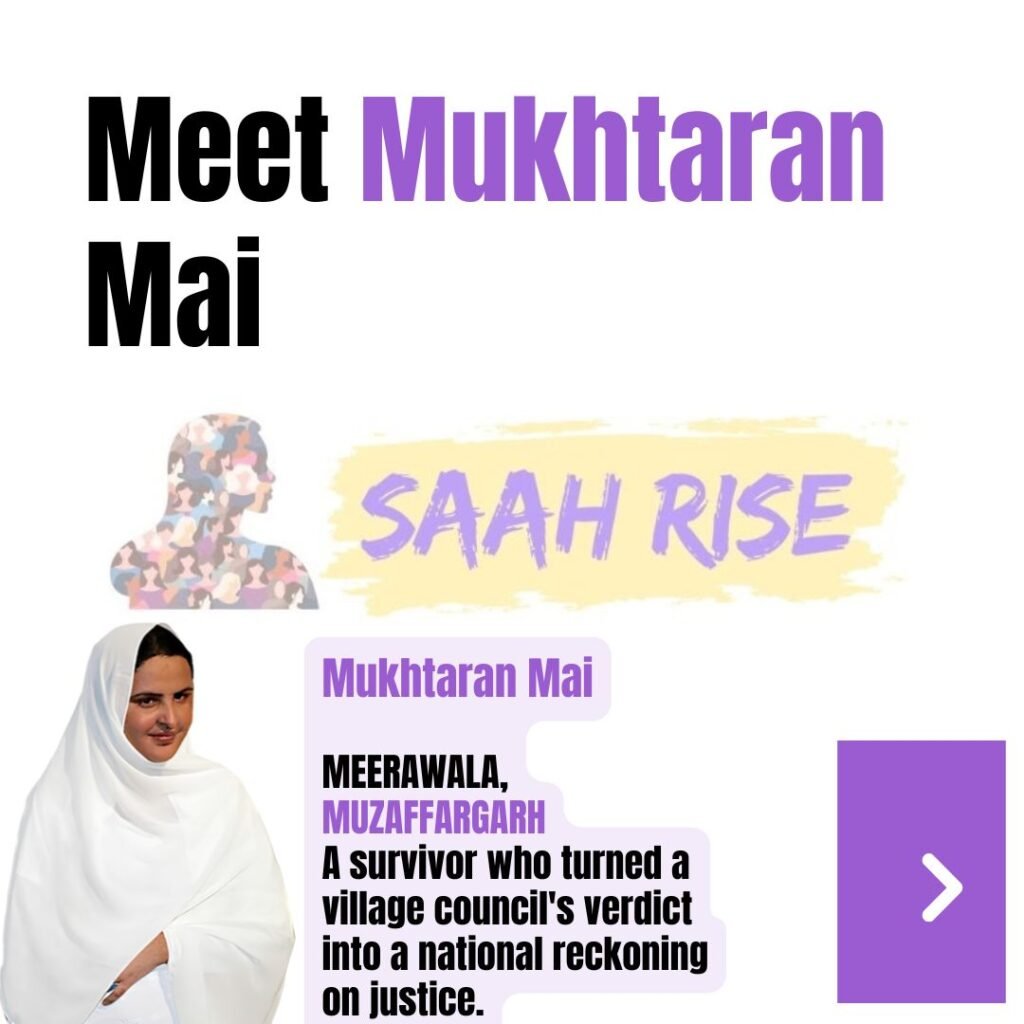
They make fun of Saraiki people. But look at the people of South Punjab especially the women of South Punjab, in a region still labeled “underdeveloped” by the rest of the country. Look at Mukhtaran Mai. This is a woman who stood against injustice, who worked for her country, and who worked, above all, for the women of South Punjab. Her name deserves to sit beside any so-called “national hero” this country has produced. And yet, how many of our own universities teach her story?
Mukhtaran Mai’s life began in Meerawala, a small village in the Muzaffargarh district a place with no paved road, no electricity, and no reliable water supply. It is the kind of village that rarely appears on a map, let alone in a history book. But in June 2002, Meerawala became the center of a national reckoning, and a woman from a Saraiki-speaking, semi-literate household became one of the most consequential human rights figures Pakistan has produced.
A Punishment Turned Into a Movement
Mukhtaran Mai’s ordeal began as what her community called a matter of “honour.” A local tribal council accused her younger brother of an offence against a rival clan, and in response, the same council sentenced Mukhtaran a woman with no part in the alleged dispute to a punishment gang rape. It was a decision made by men in positions of local authority, sanctioned by custom, and carried out in front of witnesses. In much of rural Pakistan, that would have been the end of the story. Survivors are expected to disappear quietly, or worse, to take their own lives so that the “shame” does not spread further.
Mukhtaran refused that script.
Instead of retreating into silence, she pursued a criminal case against her attackers and kept pursuing it for more than a decade, through exhaustion, intimidation, and a legal system that repeatedly failed her. She survived two suicide attempts along the way, not because she wanted to escape justice, but because the weight of fighting for it nearly broke her. Still, she returned to court. She endured resistance from local police, pressure from powerful politicians, and, in her own words captured in Dr. Fouzia Saeed’s book *Tapestry*, the “peculiar behaviour” of judges who seemed determined to make her case disappear.
The case moved through Pakistan’s courts for the better part of two decades. In August 2002, an anti-terrorism court convicted the men responsible and sentenced them to prison. Then, in 2005, the case was appealed, and the Lahore High Court released them. Pakistan’s Chief Justice at the time, Iftikhar Muhammad Chaudhry, took suo motu notice and had the men returned to custody but by 2011, in a final Supreme Court ruling, only one of the six accused remained convicted, with the court citing insufficient DNA evidence to establish it had been a gang rape. When the country’s highest court declined to describe her case as a gang rape, protests broke out from Peshawar to Karachi. Her fight had, by then, stopped being only about her own case. It had become a referendum on how Pakistan treats women who dare to speak.
Refusing the Payoff, Choosing a School
Perhaps the most telling moment in Mukhtaran Mai’s story is not one of confrontation, but of quiet refusal. When the government offered her Rs 500,000 in compensation a sum meant, in part, to make the story go away she turned it down. “No,” she said, “make a school in my village instead.”
It was not a symbolic gesture. It was policy, written in a single sentence by a woman who had never been formally educated. When international NGOs and well-wishers later began sending her money, she funneled nearly all of it into that same commitment: education, not payoff.
The irony of her own schooling is worth sitting with. As a young girl, Mukhtaran had access to only one teacher shared between two classrooms. So the teacher would instruct her one day, and Mukhtaran barely more educated than the children she was about to teach would pass the lesson down to the younger students the next day, so the teacher could continue with the older ones. That improvised, makeshift relay was how Mukhtaran Mai learned to read and write. Decades later, she built that same spirit of shared learning into a real institution, open to every child in her village, regardless of background including, by her own account, the children of the men who had once persecuted her family.
A Home Turned Into a Shelter
As her case gained national and international attention, Mukhtaran’s home in Meerawala became something it was never meant to be: a sanctuary. Women from across southern Punjab, fleeing honour-based violence or facing punishments handed down by informal tribal councils just like the one that had condemned her, began arriving at her door. She had no significant resources of her own, but she found ways through donations from women’s rights groups, through pro bono legal support, through sheer persistence to turn her home into a functioning shelter with access to legal aid. The lawyer who represented her for years, Aitzaz Ahsan, never charged her a fee, she has said, despite the scale and difficulty of her case.
The Pakistani state, meanwhile, did not always treat her as a survivor deserving of protection. When she was invited to the United States to receive an award for her courage, President Pervez Musharraf’s government placed her on the Exit Control List, confiscated her passport, and effectively held her under what officials called “protective custody.” Musharraf later told reporters in New York that some Pakistani women were exploiting rape allegations to obtain visas abroad a comment that provoked international outrage and revealed exactly how far the state’s understanding of her case lagged behind the world’s.
A Ripple Effect Across the Country
Mukhtaran Mai’s case did not just move public opinion it moved policy. Her story helped catalyze a broader alliance of women’s organizations, including the Pakistan Nari Tehreek, which launched a nationwide campaign to change public attitudes about rape, not just the law. As part of that campaign, activists coined a new Urdu term for rape moving the language away from framing built around a woman’s “lost respect,” and reframing the crime as the rapist’s shame to carry, not the survivor’s. That campaign supported parliamentary efforts that eventually removed rape from the Zina Ordinance, returning it to the Pakistan Penal Code as a distinct crime a significant shift in how the law treated survivors going forward.
Recognition, Long Overdue
Mukhtaran Mai’s bravery did not go unnoticed on the world stage, even when her own government was, at times, working against her. In August 2005, the Pakistani government awarded her the Fatima Jinnah Gold Medal for bravery and courage. That same year, Glamour magazine named her Woman of the Year in the United States. In 2006, the Council of Europe honored her with the North-South Prize for her contributions to human rights, and Time magazine listed her among the 100 most influential people in the world. She has also been widely cited as a nominee for the Nobel Peace Prize. Through it all, she founded the Mukhtar Mai Women’s Welfare Organization, which continues to run schools, shelters, and legal aid services for women and children in her region.
These honors matter but they should not be the end of the story. A woman who reshaped how an entire country talks about rape, who built schools out of a payoff she refused, and who turned her own home into a shelter for the vulnerable, deserves more than an occasional mention in an international magazine spread. She deserves a place in our curricula.
A Call to Remember
A legend like Mukhtaran Mai should not be allowed to fade from memory simply because she comes from a region too often dismissed as backward, or spoken about only in the past tense. There is a real responsibility here for government stakeholders, for universities, for academics across Pakistan to hold seminars, talks, and courses so that young people understand exactly how Saraiki communities have contributed to this country’s history of courage and reform.
South Punjab is not short on talent. It is short on platforms. Mukhtaran Mai proved what one woman from an “underdeveloped” village can do when given even a fraction of the recognition and resources of the country she serves. There are more women like her across the Saraiki belt quietly building schools, running informal shelters, fighting cases nobody else will take. They are waiting, not for pity, but for the same chance Mukhtaran Mai eventually earned: to be seen, to be heard, and to be remembered.
This piece draws on Mukhtaran Mai’s own account as recorded in* Tapestry *by Dr. Fouzia Saeed, alongside publicly reported details of her legal case, activism, and recognitions.