
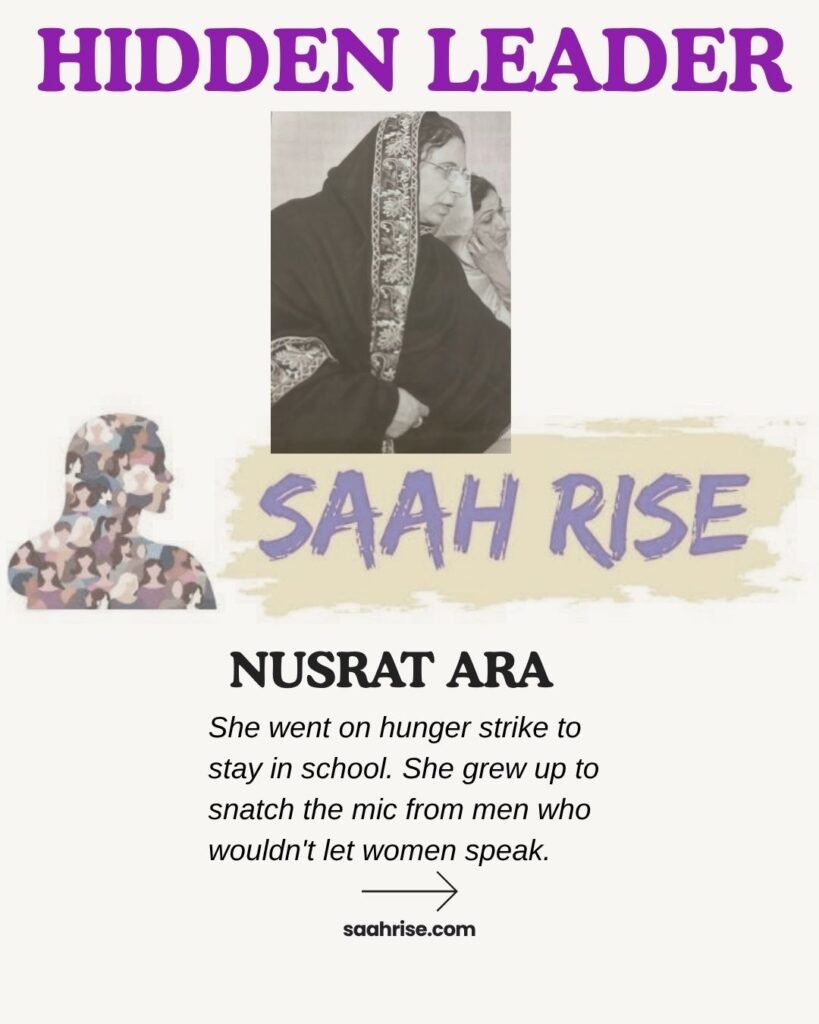
There is a particular kind of courage that doesn’t announce itself. It doesn’t come with a manifesto or a movement behind it. Sometimes it looks like a ten-year-old girl refusing to eat for two days because she wants to stay in school. Sometimes it looks like a grown woman standing up in a council meeting, walking to the front, and taking the microphone out of a man’s hand.
This is the story of Nusrat Ara a woman from Mardan whose entire life has been a quiet, relentless negotiation for the right to simply be present: in a classroom, in a marriage, in a job, in a council chamber. And who, decade by decade, won that negotiation.
A Family, a Migration, a Girl Who Wanted More
Nusrat’s family had migrated from Punjab three generations before her, settling into Mardan and assimilating fully into Pakhtun culture. It was in this context, Punjabi roots wrapped in Pakhtun tradition, that Nusrat grew up, a duality that would later be used against her, but which in childhood was simply home.
Like most girls in her extended family, she was expected to stop studying after primary school. No girl before her had gone further than the 5th grade. Her father saw no reason for her to be the exception.
But Nusrat wanted to learn, and she was willing to risk her body to prove it. She went on a hunger strike refusing food for two days until her father, hesitant and unconvinced, relented. It worked. But permission came with conditions that reveal exactly what “progress” looked like in that time and place: a tonga was arranged to carry her to school, fully covered with a chadar on all sides, and the driver was given explicit permission to use his whip if even her hand slipped out from behind the curtain.
She had won the right to be educated. She had not yet won the right to be seen.
The Tandoor and the Second Strike
Studying alone wasn’t enough. Nusrat joined the Girl Guides in secret, knowing full well her father would never approve. When she returned home late one day after a school field trip, his fury was immediate and physical. He threw her school bag, books and all, into the tandoor.
Her teacher personally came to the house to defend her, bringing proof that Nusrat had never been alone on a bus full of girls had made the same trip. It made no difference. Her father scolded her, and, following a tradition that punished mothers for the perceived failures of their daughters, he scolded her mother too.
Nusrat waited a few days and used the only leverage she had ever found effective: she stopped eating again. She fell ill quickly. It took a family friend a doctor intervening on her behalf before her father allowed her back to school a second time.
Two hunger strikes before the age of most children finish primary school. That was the cost of an education.
College, and a Family That Turned on Itself
When it came time for college, the resistance intensified, and this time it wasn’t just her father who objected, but his entire extended family, stunned that he had allowed it at all. Her own brother, always aligned with their father’s traditionalism, was, if anything, stricter about what women should and shouldn’t do. Her only consistent ally was her mother, who quietly ran interference, softening her father’s edges when she could.
This wasn’t an isolated household drama it was the norm. At the time, only about 100 young women in the whole of Mardan were attending college alongside Nusrat. Being one of them made her, by definition, unusual.
The breaking point came on the day of her final college exam. It rained so heavily that the streets flooded two feet deep, and her tonga never arrived. Desperate not to lose an entire academic year, she begged her father to let her brother take her on his motorbike instead. He agreed.
She passed her exam. But when she came home, half of her extended family was already there waiting to condemn her father. A daughter, riding through the city in full public view on a motorbike, was treated as an act of family dishonour. The extended family mocked him mercilessly. He, in turn, took it out on Nusrat and her mother.
Her mother decided, in that moment, that it was time to send her away.
Marriage, and a Husband Who Chose Her
Nusrat’s marriage had, in truth, been arranged before she was even born, a promise made between sisters, one of whom believed her daughter would have an easier life away from the social pressures of Mardan, in Sialkot. The flooded street and the family’s fury simply accelerated a wedding that had always been coming.
What followed was unexpected. Immediately after the wedding, Nusrat’s husband told her to give up the burqa. It was a decision his own family questioned — but the wider trend toward wearing just a chadar was beginning to spread, and he stood by it. Nusrat liked her husband. He supported the freedom she had been fighting for her entire life.
Then he lost his job, just before their life together had even properly begun. For a year, Nusrat lived in poverty, entirely dependent on his family. She couldn’t bear it. She convinced her husband to let her look for work, and she found a strong position managing a network of private schools.
Her own family’s reaction was explosive. They tried to physically reclaim their daughter. Her brother took up a gun, threatening to shoot both Nusrat and her husband. No violence occurred Nusrat held her ground, but her family severed all ties with her for years.
She kept the job.
Building Schools, Facing a City That Didn’t Want Her
Nusrat’s competence eventually drew the attention of the government, which recruited her to supervise its own schools. Around this period, she also began attending training sessions run by NGOs focused on political awareness sessions that exposed her to new ideas and, by her own account, helped her discover creative abilities she hadn’t known she had.
Eventually, she and her husband moved back to Mardan, where she opened a school in the Turi area. It did not go smoothly. Influential local families, used to their children passing exams without actually taking them, resisted her insistence on real academic standards. The backlash quickly stopped being about education and became personal, ethnic, gendered: she is a Punjabi in the garb of a Pakhtun. She is a woman trying to destroy our culture.
The pressure grew severe enough that she sometimes feared for her life. Eventually, she left Turi and retreated to Mardan city — not in defeat, but to build something new.
Mardan City: Theatre, Training, and a Council Seat
In Mardan, Nusrat set up an organization dedicated to social causes, alongside continued support for local schools. She wanted a platform — something built specifically to raise public awareness and expand space for women in public life. Organizations like the South Asia Partnership Pakistan (SAP PK) and the Interactive Resource Center (IRC) supported her growth during this period.
She started the first women’s theatre group in Mardan and made a point of pushing women into seminars, trainings, and political gatherings — spaces designed to build exposure and connections that women in her city had rarely been allowed to access. The Mardan she now lived in felt, in her own words, unrecognizable from the Mardan of her childhood.
Then came 2001, and Pakistan’s local bodies elections. Omar Asghar Khan, then Minister of Local Government under Musharraf, lent his ministry’s backing to help ordinary people engage with this new political opportunity and Nusrat threw herself into mobilizing women to participate.
The women she organized kept asking her the same question: if you think this is such a good thing, why don’t you run yourself?
After a long, serious conversation with her husband, she decided to take up the challenge. She faced deliberate bureaucratic resistance from low-level clerks trying to slow her down and pushed through anyway, submitting her nomination papers complete and on time.
She won.
Taking the Mic
Winning opened an entirely new world. Nusrat moved quickly from union councillor to district councillor. But arriving in the chamber didn’t mean being heard in it. Early on, men simply didn’t let women speak in meetings.
One day, Nusrat had had enough. She walked up and took the microphone out of a man’s hand and used it to lay out, in front of everyone, exactly how the system had been rigged against women’s voices. She pointed out that the chairman always angled his chair toward the men, meaning he never even saw women raise their hands. She pointed out that he made sure all the men spoke before the lunch break, so that by the time it was the women’s turn, more than half the men had already left the room.
The chairman was embarrassed. From that day forward, every councillor was called strictly by turn. Nusrat went on to push for government development funds for Mardan.
Coming Full Circle
Years later, Nusrat’s father called her. People kept approaching him, he said, to praise his daughter, telling him she was a good example, that she had somehow managed to stay tied to tradition while still building a public life of service.
Nusrat cried when she heard it. Not because the praise mattered in itself, but because of what it represented: a slow, real transformation she had lived through and helped cause. Her own family had changed. Her in-laws had changed. Her neighbours had changed. Even a place as hostile to her as Turi had changed.
As she put it herself: somebody has to become.
A Note on the Men in Her Story
It would be easy to tell this story as one woman against an unbroken wall of resistance. But that isn’t quite accurate, and Nusrat herself never tells it that way. In her own words, reflecting on her journey:
“I had my husband as my support system. He made me who I am.”
A father who, however reluctantly, relented twice when his daughter refused to back down. A doctor who intervened on her behalf. A teacher who personally walked her home to defend her. A husband who told her to set the burqa aside before society pressured him to make her, and who stood by that decision even when his own family questioned it.
None of this erases the gun her brother pointed at her, or the years her family cut her off, or the men who wouldn’t let her speak until she took the microphone by force. Resistance was real, and it was constant. But so was this: at key turning points, specific men chose to stand beside her instead of in front of her — and that mattered too.
That, perhaps, is the real definition of positive masculinity: not the absence of resistance in the world around a woman, but the presence, at the right moments, of men willing to hand her the mic instead of holding onto it.