
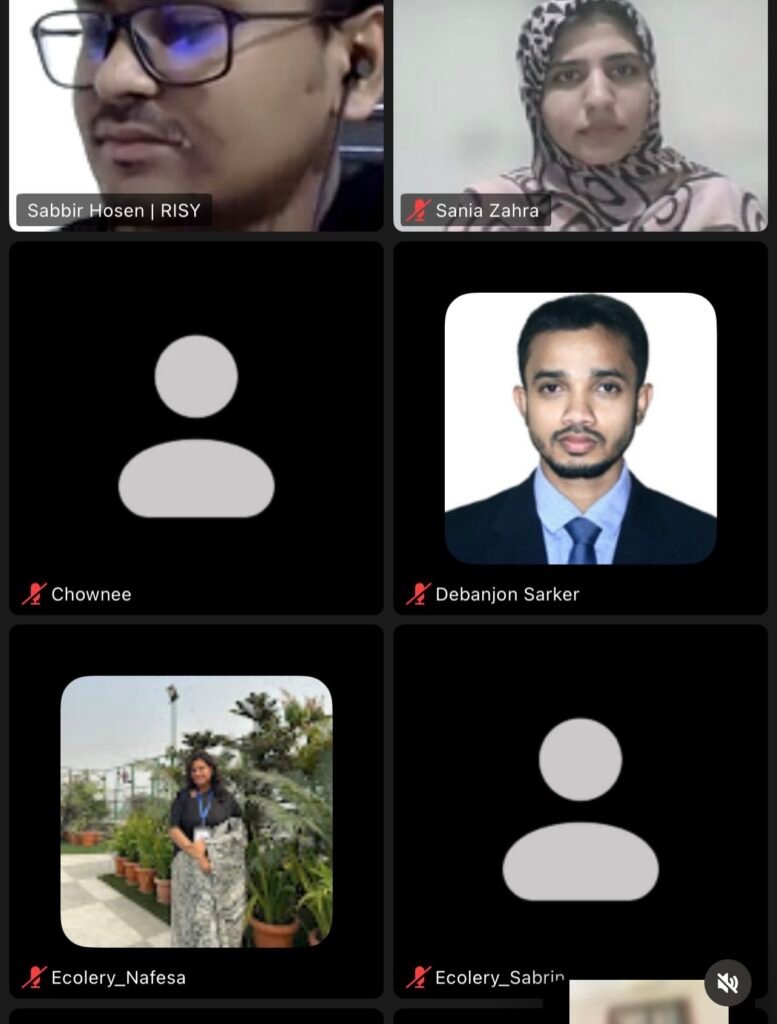
Pakistan and Bangladesh share more than geography and history; they share the daily, lived struggle of women trying to claim space in patriarchal systems, in classrooms, in policy rooms, and in the stories that get told about them. This collaboration is an invitation to learn from each other, to compare notes on what has worked in South Punjab and what has worked in Bangladesh, and to imagine a feminist future that is regional rather than isolated.
The Voices Behind the Vision
What makes this collaboration exciting isn’t just the institutions involved, it’s the people. SAAH RISE brought together a team whose diversity of discipline and background reflects exactly the kind of intersectional thinking this partnership calls for.
Sania Zahra, a medical anthropologist, introduced her work at the intersection of health, culture, and gender, a reminder that women’s bodies are never just biological facts, but sites where culture, medicine, and power all meet.
Anoosha Babar brought a different but equally vital lens, sharing her work on masculinity. Too often, conversations on gender equality leave men and boys out of the frame entirely. Anoosha’s work insists that unpacking masculinity is not a detour from feminist work it is central to it.
Sohaib Ali, joining from Gilgit with a background in mathematics and economics, introduced a perspective grounded in data and structural analysis proof that gender justice work needs number-crunchers and systems-thinkers just as much as it needs storytellers.
Muzamil Hussain, a student of Gender Studies and a published writer, spoke about his own body of published work as a reminder that the pen remains one of the oldest and most enduring tools of advocacy.
Meera Chandio, currently pursuing her BS in Social Work, shared her ongoing, hands-on work with women in her community, the kind of grassroots engagement that keeps movements honest and rooted in reality rather than theory alone.
Other team members carry their own commitments alongside this initiative, each adding a thread to the larger fabric SAAH RISE is weaving.
Why This Collaboration Matters
At its heart, this is not simply an institutional handshake between two organizations. It is a chance to build a South Asian feminist network one where a medical anthropologist in Islamabad can learn from an activist in Dhaka, where economic analysis from Gilgit can inform advocacy strategy in Bangladesh, and where stories of resilience can travel freely across a border that too often limits the movement of everything else.
SAAH RISE remains committed to storytelling, advocacy, climate justice, and ecofeminism rooted in South Punjab and KP and partnerships like this one with RISE Foundation Bangladesh only deepen that mission, extending it beyond national lines into a shared regional conversation about what a more just, more equal South Asia could look like.
We are just getting started. Watch this space for more as the collaboration unfolds.