
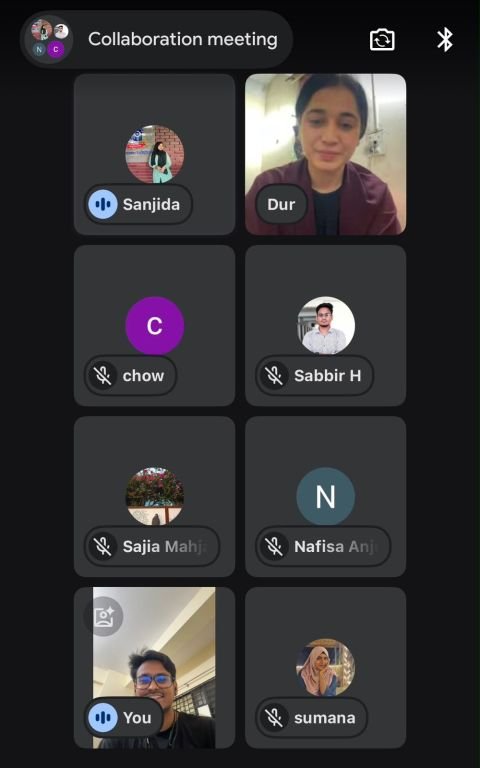
Some conversations end when the call disconnects, and there are conversations that stay with you long after reshaping the way you see your own work. Yesterday’s exchange with our Bangladeshi activist friends from RISE Foundation was the second kind.
For one hour, two countries, two histories, and two generations of women’s movements sat in the same virtual room and by the end of it, borders felt like the least interesting thing about us.
Introducing SAAH RISE to New Friends
I had the privilege of presenting SAAH RISE our mission of storytelling, advocacy, action, and hope for resilient and inclusive social empowerment, to a room full of committed activists. I spoke about why we started this initiative: to make sure the women shaping our communities are not forgotten simply because no one wrote their stories down. I talked about the challenges we’ve faced along the way, from resourcing our work to convincing people that grassroots stories deserve the same dignity as headline news. And I shared how, at SAAH RISE, we don’t just document women’s stories — we train the next generation of young women leaders to tell their own.
It was humbling to introduce my team to them, including Vikash Kumar, my brother, my friend, and my colleague, whose presence in our work is itself a quiet, powerful statement about how minorities live and lead alongside the rest of us in Pakistan, in peace and partnership.
Honouring the Women Who Came Before
I couldn’t talk about Pakistani women’s leadership without mentioning Fatima Jinnah — one of the greatest women leaders our country has produced. Long before Partition, she was already breaking ground as a dentist and as a public figure engaged in political life, at a time when very few women had access to either profession or platform. Alongside her, I highlighted the brave grassroots women leaders working today, far from the spotlight, whose courage is the very reason SAAH RISE exists.
A Shared Land, Many Languages
I also gave my friends a small window into Pakistan’s landscape and its linguistic richness. Saraiki, Pashto, Sindhi, Punjabi, Balochi, and many other regional languages carry the histories and identities of our people. It meant so much that our Bangladeshi friends were genuinely curious about this diversity, and even more special that we ended up conducting half our conversation in Urdu, because they wanted to learn it, live, in real time.
The Line That Stayed With Me
Mr. Sabbir and his incredible team at RISE Foundation encouraged me more than words can capture. Amid all the discussion, Sabbir offered a line I know I’ll carry into every future conversation about our work:
“Humanity comes before borders.”
That’s it. That’s the whole point. Whether in Lahore or Dhaka, in Multan or a remote village in Bangladesh, we are all activists working for humanity within our own communities and the border between our two countries dissolves the moment that becomes clear.
Women Doing the Work
Every woman on that call was doing something remarkable. Sanjida’s work running a school in a remote area of Bangladesh stood out to me in particular a reminder that education, delivered with love and persistence in the hardest-to-reach places, is one of the most radical acts of empowerment there is.
Ending in Poetry
We closed our session the way only a room full of people who love language and each other’s cultures could: with Nafsia singing the poetry of Ghalib. An hour that began with introductions ended in verse — and somewhere in between, we stopped being “Pakistani” and “Bangladeshi” activists and simply became a room full of people who care.
What This Means for SAAH RISE
The most beautiful part of this exchange was watching my friends fall in love — with Pakistani culture, with our women’s stories, with our languages. They didn’t just listen; they asked how they could participate, how they could help, how they could be part of what we’re building at SAAH RISE.
That question is the whole reason cross-border solidarity matters. Movements for women’s rights and dignity don’t need to compete for space — they need to link arms. If our work in South Punjab can inspire a school in rural Bangladesh, and if a school in rural Bangladesh can inspire us right back, then we are exactly where we should be.
To Mr. Sabbir, Sanjida, Nafsia, and the entire RISY Foundation family: thank you for reminding us that humanity really does come before borders. This is only the beginning of what I hope is a long, warm collaboration.
If you’re inspired by this story and want to know how you can support or collaborate with SAAH RISE, reach out to us — we’d love to have you join this growing circle of cross-border friendship.