
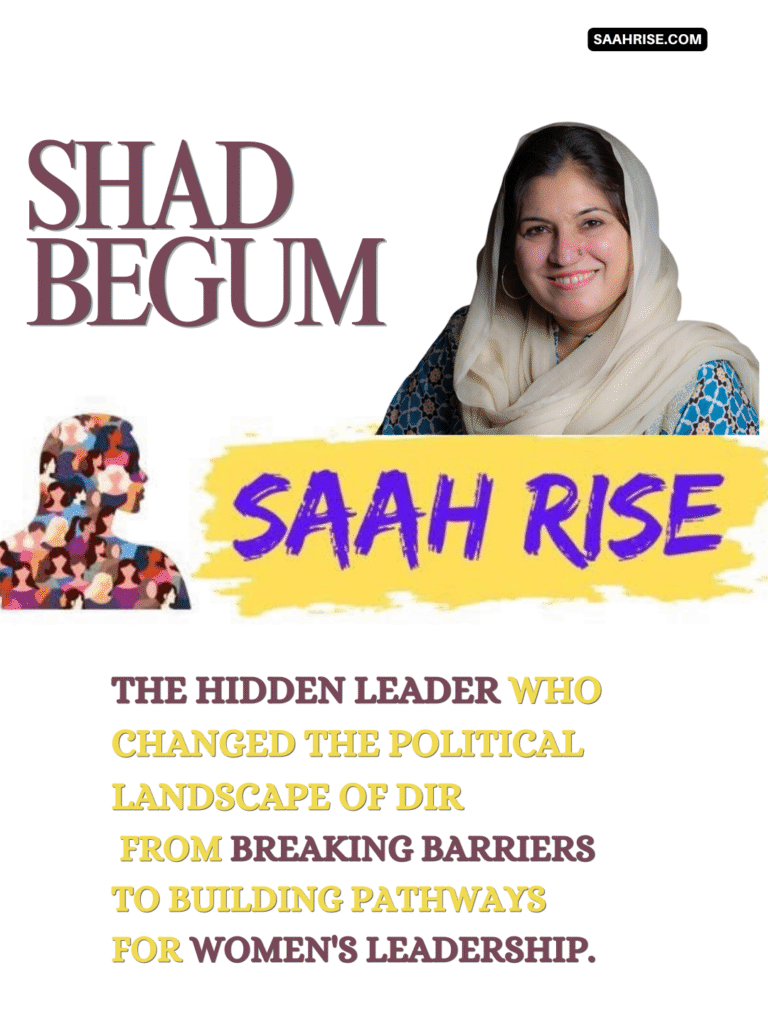
The mountains of Lower Dir keep their secrets close. In 2001, one of those secrets was an agreement — quiet, unanimous, and absolute. Every community leader, every political party, every man who held any power in the district had come to the same conclusion: no woman would vote. No woman would campaign. No woman would so much as approach the idea of a ballot box.
Into that silence walked Shad Begum, and she refused to accept it.
A Childhood Built on Conviction
Shad was born in Kalpani Talash Village, in Tehsil Timergara, Lower Dir a place where she completed her early schooling before going on to earn a B.A. and B.Ed. privately. But her real education came from her parents. Her mother was a schoolteacher. Her father was a homeopathic doctor who, in 1970, founded a small welfare organization for his village called Idara-e-Khidmat-e-Khalq (IKK).
Shad wanted the organization to serve women, too. It sounds like a modest ask. It wasn’t. Even the simple act of bringing family women into IKK’s meetings provoked a sharp social backlash so sharp that the only way forward was to build something separate entirely. That became Anjuman Behbud-e-Khawateen Talash (ABKT), a women-only chapter registered in its own right. Under Shad’s leadership, ABKT trained women in health, education, and micro-credit, and slowly, village by village, her network spread across the old princely state of Dir.
She married a schoolteacher, had two sons, and kept building. As she puts it:
“We started small, but we had a big dream — that women too deserve a voice and a choice.”
The Year Everything Changed
When local elections were announced in 2001, Shad learned that women had been formally banned from taking part. Political parties and tribal elders had reached a rare consensus — and rare consensus, in Dir, was not something easily undone.
Shad wrote to the Election Commission. She negotiated with elders. She pushed her networks to create enough noise that the ban couldn’t simply sit unchallenged. When resistance hardened, she did something few would have dared: she became a candidate herself, just to prove it could be done.
The threats that followed were not abstract. There was an open warning that any man who submitted a woman’s nomination papers would be killed. Six men did it anyway. All six women they nominated won unopposed, out of 28 union councils in the district.
It was a crack in a wall that had never once been tested.
Winning Without Hiding
In the following council elections, the arithmetic of power shifted in a way no one had predicted: councils needed a quorum of women members to legally meet. Suddenly, the same men who had opposed women’s participation needed women on the books — even if only to sign a register at home and never attend a session.
Shad refused that version of “inclusion.” She ran for a general seat, not a reserved one, and won it outright, with both women and men voting for her. It made her a target for resentment inside the council chambers. Male members tried to sideline her, blocked women on reserved seats from attending meetings, and once argued that a school visit by women committee members would be “un-Islamic.” Shad kept speaking. Her objections became so persistent that some committees simply stopped meeting altogether rather than face her.
By 2005, the old consensus against women reasserted itself. This time, Shad set up a legal aid camp directly outside the Election Commission’s office in Lower Dir, helping women file their own candidacy papers in public view. Political parties, wary of being outflanked, began fielding women of their own. Even so, intimidation ran deep: female polling staff were sent home, women voters were turned away, and across the entire district, only 94 women managed to cast a vote. Yet 124 women now held reserved seats unopposed. The wall was cracking further.
“Courage is not the absence of fear, but the decision that something else is more important.”
Presence Was Never Enough
Shad went on to win a seat on the District Council an indirect election decided by fellow councillors running as an independent, even as parties lined up to court her. Inside, she found a new obstacle: physical segregation. Women could listen to proceedings. They could not speak. They could not even see the men they were meant to be legislating alongside.
So she trained them instead. Working with civil society partners, she taught women councillors how the system worked and how to use whatever voice they had within it. When male colleagues tried to placate women members with sewing machines and craft centres — a unilateral, symbolic gesture rather than any real transfer of power Shad rejected it outright. The centres, built without genuine buy-in, closed soon after.
“It’s not enough for women to be present; they must be heard, they must lead.”
The Cost of Refusing to Stop
By 2008, militancy in the region had escalated sharply, and the threats against Shad turned serious enough that security agencies advised her to leave. She moved to Islamabad, though the transition was hard by her own account, she struggled even with Urdu in a city where English was often assumed. She returned to Peshawar instead, throwing herself into work with families displaced by the conflict in Swat.
In 2012, she received the Woman of Courage Award in the United States, a recognition that, in turn, brought her renewed visibility at home. That same year, the Taliban’s attack on Malala Yousafzai sent a chilling reminder through her own family: Shad had been receiving threats from the same forces long before the world learned Malala’s name. Security agencies pushed her out of the province once more. This time, Islamabad became permanent.
A Rule That Outlived the Resistance
Shad’s decades of pressure eventually reached the Federal Election Commission itself. Her movement helped secure a rule that is still in force today: election results at any level can be invalidated if fewer than ten percent of eligible women cast their votes. It is a quiet, procedural safeguard — and it exists because one woman from Kalpani Talash refused to let an entire district’s consensus stand unchallenged.
Shad Begum remains a respected voice in Pakistan’s women’s rights movement. Her own words capture the patience her fight demanded, without ever asking her to give up its urgency:
“Change takes time. To avoid severe consequences, we sometimes have to go along with traditions as we gradually create space for ourselves. Mindset shifts and social transformations always take time.”