
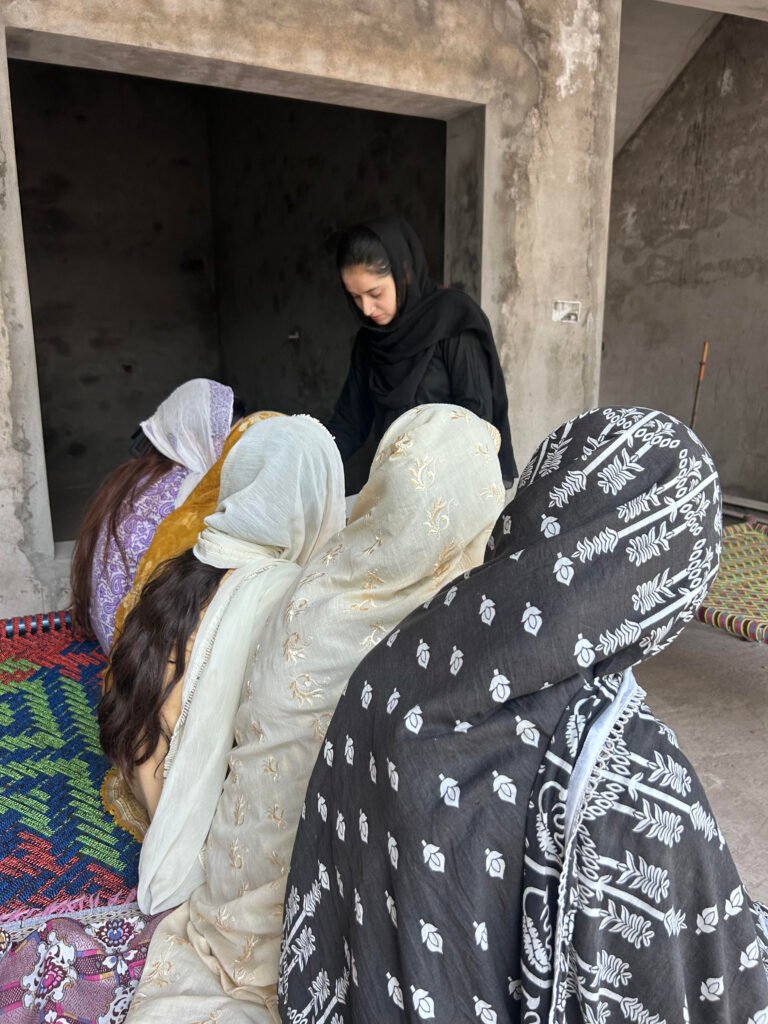
There is a particular kind of neglect that South Punjab knows intimately. It is the neglect of a region whose language is spoken by millions but rarely heard in policy rooms. It is the neglect of a land that floods again and again, whose people rebuild again and again, and whose women are asked to endure quietly, again and again. It was into this neglect and against it that SAAH RISE walked in collaboration with Baithak, to hold a session in Khan Garh that most conversations about climate change never dare to touch: the connection between a warming, flooding world and the monthly reality of menstruation.
Why Khan Garh, Why Now
Khan Garh sits in the heart of a region that has borne the weight of Pakistan’s climate crisis more than almost anywhere else. Muzaffargarh and its surrounding areas were among the hardest hit by the catastrophic floods that have repeatedly submerged South Punjab in recent years, leaving behind displaced families, damaged homes, and disrupted access to even the most basic services. For women and girls, disruption doesn’t pause for biology. Periods do not stop because a heatwave has settled over the district or because floodwater has swallowed the road to the nearest clinic. If anything, these crises make menstrual health harder to manage and far more dangerous to ignore.
This is precisely why SAAH RISE chose to center the session here, in Saraiki, delivered by our own founder. In a region where the Saraiki language and identity are so often sidelined in mainstream discourse, speaking to women in their own tongue was not a small choice; it was the whole point. It meant every metaphor landed, every question could be asked without translation getting in the way, and every woman in that room understood, without a shadow of hesitation, that this conversation was being held for them, not delivered at them.
The Conversation Nobody Has
Our founder walked participants through something that development and climate conversations routinely skip: the direct, physical toll that climate stress takes on menstrual health. In climate-vulnerable districts like Muzaffargarh and Khan Garh, extreme heatwaves and recurring floods don’t just damage crops and homes,s they strip away the conditions women need for basic menstrual care. Clean water becomes scarce exactly when it’s needed most. Privacy disappears when families are displaced into shared shelters. Access to sanitary products, already limited in rural South Punjab, becomes nearly impossible when roads are washed out, and markets are underwater. Heat intensifies discomfort and health risks during menstruation, while floods bring the added danger of infection in unsanitary, waterlogged conditions.
These are not abstract policy points. They are the lived, monthly reality of the very women who sat in that room, om women who have survived floods, who know the heat of a Muzaffargarh summer intimately, and who, until this session, had likely never heard anyone connect their climate hardship to their menstrual health out loud.
Burning the Myths, Not Just Naming Them
The session’s most powerful moment came through a myth-burning activity,ity a ritual as symbolic as it was cathartic. Participants wrote down the myths and taboos they had grown up carrying about menstruation: the whispered restrictions, the shame passed down through generations, the misinformation mistaken for tradition. Then, together, they burned them.
There is something deeply fitting about the act of burning myths in a region that has just survived floodwater as if to say that fire, too, can be a form of cleansing, a way of reclaiming what water once tried to wash away. It was a small circle of women, but the symbolism was enormous: five rural women, a college student, a schoolteacher, and three high school girls, standing together and refusing to let silence and misinformation be inherited by the next generation.
Who Was in the Room
What made this session powerful wasn’t scale; it was depth. The participants spanned generations and stages of life: rural women who carry the daily burden of managing their households through climate shocks, a teacher who will carry this conversation back into her own classroom, a college student building her own path forward, and three high school girls who are only just beginning to understand what their bodies and their world will ask of them. Every one of them left not just with information, but with permission to speak, to ask, to reject shame that was never theirs to carry in the first place.
Why This Matters Beyond Khan Garh
Climate justice conversations in Pakistan, and globally, too often stop at crops, infrastructure, and displacement figures. They rarely descend into the body into the specific, gendered ways that climate stress reshapes women’s health and dignity. By holding this session in Khan Garh, SAAH RISE and Baithak insisted on a more honest, more complete climate conversation, one that recognizes menstrual health as climate resilience, not a footnote to it.
South Punjab does not need to be spoken about. It needs to be spoken with, in its own language, about the realities its people actually face. This session was one small, determined step in that direction, a reminder that grassroots advocacy, delivered with cultural rootedness and unwavering care, can hold space for the conversations that bigger platforms keep avoiding.
To every woman who sat in that circle in Khan Garh, and to Baithak for standing beside us in this work: this is only the beginning. South Punjab’s women deserve to be heard, in their own language, on their own terms, and SAAH RISE remains committed to making sure that they are.