
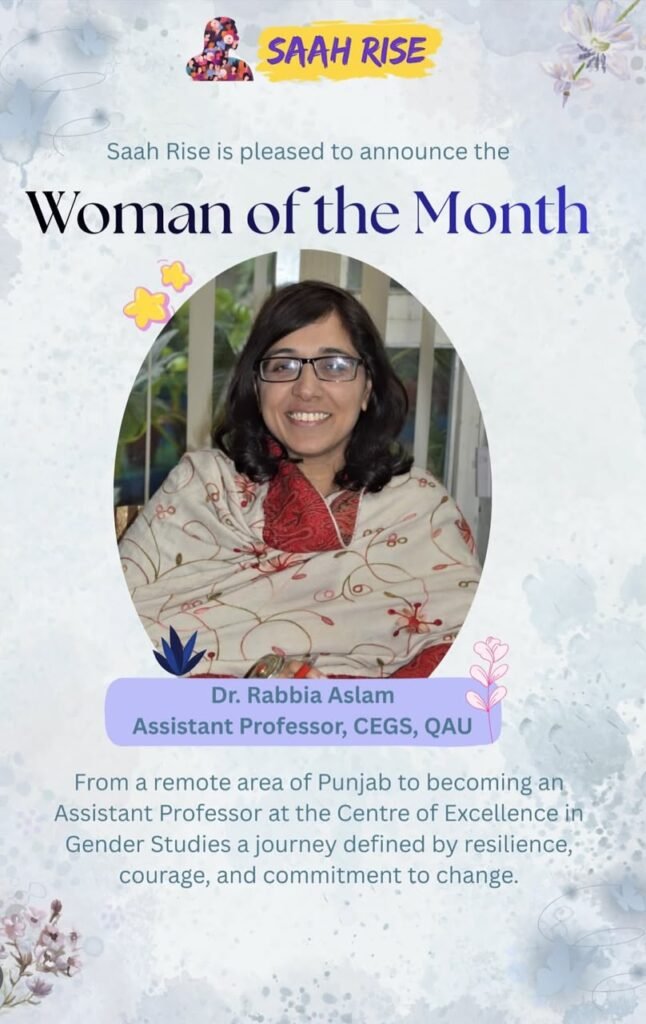
The journey of a leader is rarely a straight line, especially for women navigating traditional societal structures. In the video interview, an Assistant Professor of Gender Studies Dr Rabbia Aslam shared her inspiring story of defying norms, pursuing higher education, and balancing a successful career with family life. Her narrative is a testament to the power of persistence and the crucial role of supportive male allies.
Breaking the Village Tradition
Coming from a village in Punjab, she grew up in a family where education was valued but highly gendered. While the men in her family typically traveled to cities for higher education, women were generally expected to study only as far as the local village or city schools allowed—usually up to the matriculation level. Her elder sister completed a bachelor’s degree locally before getting married, but the interviewee felt a drive for something more.
In 2005, she became the first woman in her generation to leave her area to study in another city and live in a hostel when she gained admission to Fatima Jinnah Women University. Despite the lack of local universities in areas like Sargodha at the time, she pushed for the opportunity, eventually convincing her father to let her go.
Early Career Struggles and Financial Independence
Her professional journey began even before she finished her Master’s thesis. While attending a seminar, she was offered a job with a starting salary of just 7,000 PKR—an amount that didn’t even meet the minimum wage requirements at the time. Despite the low pay, she took the role to gain experience, often doing unpaid internships and volunteer work to build her resume.
Her pursuit of an MPhil in Sociology at International Islamic University brought further challenges. As a semi-government institution, the fees were high. Her father assisted her financially, despite facing criticism from relatives who felt he had given her “too much freedom”. For her, the goal was always clear: she wanted to be truly independent.
Navigating Social Pressure and Rumours
One of the most significant hurdles wasn’t the work itself, but the “distractors” within the extended family and community. She faced various forms of social policing, including:
- Stereotypes about working women: Relatives often suggested that women working away from home were “not good”.
- Harassment: She dealt with “prank calls” from extended family members trying to “check” on her behavior.
- Rumours of abandonment: When she was selected for the International Visitor Leadership Program (IVLP) in the United States, people spread rumours that she would never return to Pakistan.
Throughout these trials, her father remained her shield. When people called to “verify” her conduct, he would tell them that if they needed a guarantee of her character, they should speak to him directly rather than bothering her.
The Global Stage and Academic Success
Her career progressed from being a researcher to becoming a lecturer at Allama Iqbal Open University, and eventually securing a competitive position as an Assistant Professor. She emerged as a leader through various platforms:
- International Exposure: She attended a leadership summit in Nepal and the prestigious IVLP program hosted by the US Department of State.
- Academic Achievement: She secured her current teaching post by outcompeting 70 other applicants for only four available seats.
The Myth of the “Perfect Balance”
Now a mother and a professional, she is candid about the challenges of the “dual role.” She rejects the idea of being a “perfect” person with flawless management skills. Instead, she focuses on priority and quality of time.
“I cannot keep every window and mirror sparkling clean,” she admitted, noting that she refuses to let household perfectionism get in the way of her research or her children’s needs. For her, “quality time” means being fully present with her children—discussing what they are reading or playing with them rather than worrying about office work during family hours.
A Call for Positive Masculinity
A recurring theme in her story is Positive Masculinity. She attributes much of her success to the “conducive environment” provided by her father, brothers, and husband. She believes that for women to truly progress, men must realize that supporting a woman’s independence actually benefits the entire family.
Her message to the younger “Gen Z” generation is firm: Do not be disheartened by critics. She encourages young women to remain clear on their path, noting that “you cannot please everyone in the world”. Whether a woman chooses a career or a role in childcare, her strength lies in being financially and mentally empowered to make those decisions for herself