
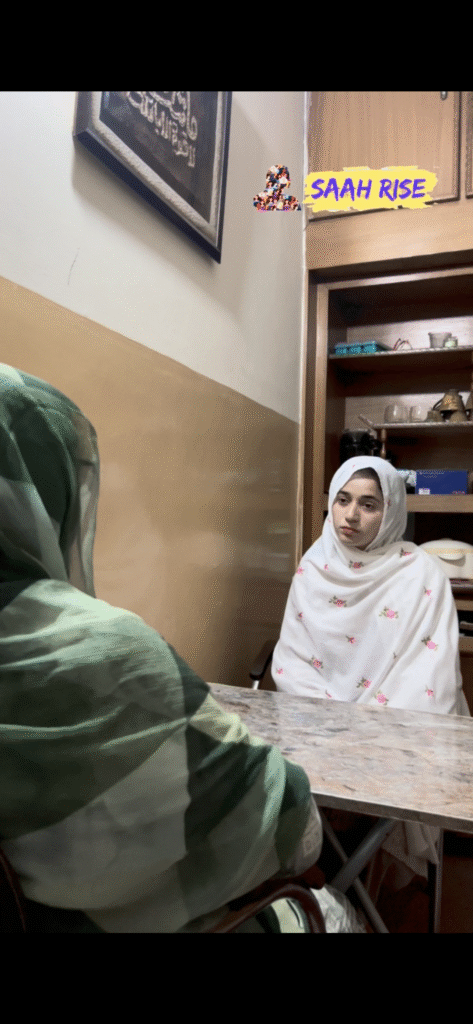
In the tapestry of women’s leadership in Pakistan, stories from the grassroots often reveal the most profound lessons in resilience, agency, and quiet revolution. SAAH Rise recently had the privilege of interviewing a remarkable grassroots woman leader from the Urdu-speaking community. Her narrative, beginning with the evocative words “Zindagi ka safar to…” (Life’s journey is…), unfolds as a testament to personal strength forged through adversity.
A Life Marked by Early Loss and Unwavering Support
Our interviewee lost her mother in childhood, a tragedy that could have derailed many young lives. Yet, her father emerged as a pillar of strength and a shining example of positive masculinity. He consistently emphasized education as non-negotiable, declaring, “Jo bhi halat ho, taleem dilwani hai” (No matter the circumstances, education must be provided). This commitment persisted even after her mother’s death, enabling her to complete her Bachelor’s degree (BA).
She remains deeply grateful: “I am very thankful to my father because without him I wouldn’t have been able to get an education, a job, and raise my children.” Her story powerfully illustrates how supportive male figures within families can dismantle barriers and create pathways for women’s empowerment.
Marriage, Motherhood, and the Weight of Responsibility
Life took a complex turn when she married a man who already had a wife and four daughters. Far from the stereotypical narratives, she describes him as a “good and supporting husband.” She embraced the blended family with grace, caring for his four daughters as her own, ensuring they were married, while also raising her two biological children.
The real turning point came with tragedy: her husband’s untimely death in a road accident. Suddenly, she found herself solely responsible for a large household. With young children to support including the four stepdaughters, she entered the workforce. Balancing a job, homemaking, and childcare was immensely difficult, yet these struggles cultivated profound resilience.
Education as the Lifeline
Her education proved to be the critical anchor during the crisis. The skills and qualifications from her BA enabled her to secure employment, providing financial stability and a sense of purpose. In her words, education was not merely academic—it was the tool that allowed her to navigate widowhood, raise children, and support an extended family.
This aligns with broader scholarly understandings in gender and development studies: education acts as a multiplier of agency, particularly for women in patriarchal and resource-constrained contexts. It equips them not only with economic independence but also with the psychological fortitude to rebuild lives amid loss.
Reflections on the Urdu-Speaking Community
When asked about her community in Islamabad, she noted that while representation of Urdu-speaking women in visible leadership roles remains relatively limited, the community deeply respects women and actively supports their education and employment. Education, she stressed, is viewed as compulsory. This cultural emphasis on learning, combined with familial encouragement, challenges monolithic portrayals of conservative communities and highlights pockets of progressive values that foster women’s advancement.
A Message to Young Girls: Ambition Amid Struggle
Her message to young girls, especially those from remote or small-city backgrounds, is both realistic and empowering:
“They work really hard and go through a lot of struggle to get themself out of a small city. The new era requires education, especially for women. We have to do struggles in every sphere of life… Young girls are now ambitious.”
She underscores that Allah supports human effort in every matter, blending faith with action-oriented resilience. Her journey exemplifies how ambition, when paired with education and perseverance, can transform personal adversity into collective inspiration.
Scholarly Insights: Themes of Resilience and Feminist Leadership
From an MPhil-level perspective in Gender Studies or Development Studies, this narrative enriches several key discourses:
- Intersectionality in Pakistani Contexts: Her story intersects class, widowhood, blended family dynamics, and linguistic community identity, revealing how multiple identities shape women’s leadership trajectories.
- Positive Masculinity: The father’s role disrupts toxic masculinity tropes, offering a model where male support actively advances gender equity.
- Informal Leadership: Grassroots women leaders often exercise influence through everyday acts of caregiving, economic provision, and community modeling rather than formal titles—expanding traditional definitions of leadership.
- Resilience Theory: Psychological and sociological resilience here emerges not as innate but as cultivated through education, faith, and iterative struggle.
Such stories are vital for SAAH Rise’s mission of rewriting narratives, challenging patriarchal norms, and amplifying women’s leadership as the norm rather than the exception.
Conclusion: Sparks of Change
This grassroots leader’s journey from orphanhood to matriarch, from loss to purposeful leadership, embodies the spirit of SAAH Rise. She proves that women’s leadership blooms not despite hardship, but often because of the resilience it demands. Her life calls upon us all, families, communities, and policymakers, to prioritize girls’ education, recognize positive male allies, and create enabling environments where women can thrive.
To the young women reading this: Let her story be your spark. Education is your foundation. Struggle is temporary. Leadership is your birthright.
We at SAAH Rise are committed to documenting and amplifying such voices. Share your own story or nominate a woman leader by reaching out to us. Together, we rise.