
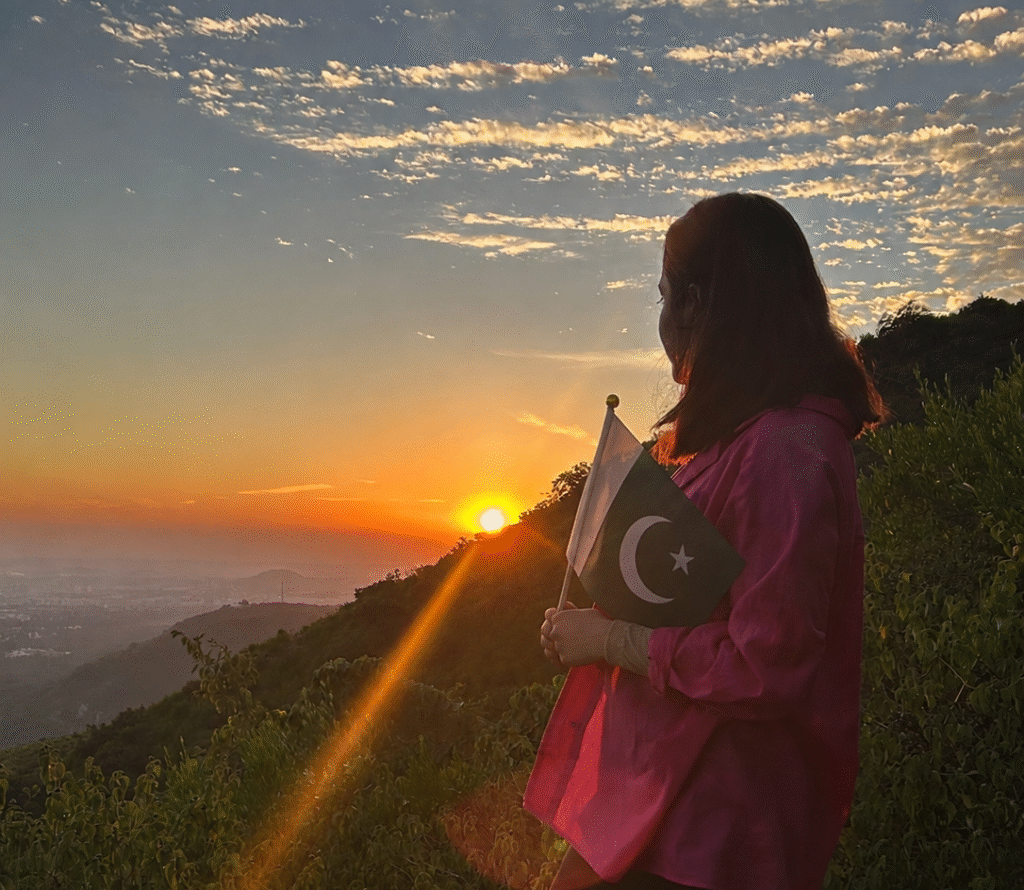
Every August, the flags go up. Green and white bunting stretches across markets in Lahore, Multan, Rawalpindi, Quetta. Children wave paper flags on rooftops. The national anthem plays on loop. We call it Azaadi — freedom, independence, the day we stopped answering to anyone else.
But ask a woman what freedom feels like, and the flags start to look different.
Because for millions of women and girls across Pakistan, Azaadi has never quite arrived at their doorstep. It waves from the rooftop, but it doesn’t walk through the front door. Independence, for a woman, is conditional. It comes with a signature required, a male relative’s nod, a “let’s see,” a “we’ll ask your father.” It is not a right she is born with it is a privilege she must keep re-earning, at every age, from every person who claims authority over her.
So this Independence Day, we’re asking the question plainly: Azaadi — is it for everyone?
A Girl Needs Permission to Simply Exist
It starts early. Before a girl can read, before she understands what a “right” even is, she is already learning to ask.
She needs permission to go to school. In many households, especially in rural and under-resourced areas, that permission is never granted at all daughters are pulled out to help at home, married off young, or simply never enrolled because a son’s education is considered the safer investment. She needs permission to go out and play, to walk to a neighbour’s house, to exist outside four walls without an escort.
And when permission is granted, safety is far from guaranteed. Studies and helpline data from child protection organisations in Pakistan consistently point to the same devastating reality: a staggering majority of girls experience some form of harassment or abuse before they reach adulthood. Nearly nine in every ten. That is not a statistic — that is almost every girl you know.
We saw this horror in its most unbearable form just recently, in the case of Baby Aizal, an 18-month-old girl in Karachi’s Qayyumabad who was raped and murdered by a 17-year-old relative someone her mother had trusted, someone who had taken her out for snacks before. Aizal’s mother, raising her alone after her husband abandoned them, is now fighting not just grief but a legal system that is debating whether her daughter’s killer is too young to be held fully accountable. A confessed perpetrator. A dead child. And still, the system finds room to hesitate.
If an eighteen-month-old is not safe, then no promise of “when she’s older, we’ll let her go out” ever meant anything at all.
Puberty Brings a New Kind of Cage
She survives childhood if she’s lucky and then puberty arrives, and with it, a different pressure: shaadi. Marriage stops being a future milestone and becomes an urgent, looming deadline, often decided by everyone except her.
If she dares to choose her own partner to fall in love, to want a say in the single most defining relationship of her adult life she is rebranded overnight. Characterless. Shameless. A disgrace to the family name. In the most extreme and most horrifying cases, that “disgrace” is washed away with her blood, in the name of an “honour” that was never hers to protect in the first place. Pakistan continues to record hundreds of so-called honour killings every year, the vast majority of victims women and girls whose only crime was choosing.
Freedom to love. Surely that’s a basic one. And yet.
Educated, Qualified, Still Asking Permission
She studies. Sixteen years of education. Eighteen. She earns a PhD, walks across a stage, holds a degree that says she has mastered a field most people never even attempt. And still she needs permission for a job. From a father. A husband. An older brother who has never opened a textbook past matriculation but somehow holds veto power over her career.
And if permission is granted, the workplace does not promise her safety either. She may face harassment from colleagues, bullying from superiors who resent a woman succeeding in a room built for men, or violence in its most disfiguring form.
This June, the country watched in horror as Dr. Mahnoor Nasir, a 29-year-old postgraduate trainee doctor, was attacked with acid inside Civil Hospital Quetta inside her own workplace, inside a government hospital, a place meant to heal people. A hospital employee threw acid on her and fled; she suffered burns across roughly a seventh of her body, to her face, her abdomen, her hands. Doctors across Balochistan went on strike. Women’s rights groups called it what it was: gender-based violence, plain and simple. Pakistan has had a law against acid attacks since 2011, carrying sentences of fourteen years to life and still, corrosive acid remains cheap and easy to buy in informal markets, still women in white coats are not safe standing in their own wards.
She earned her seat in that hospital through years of sacrifice. The system could not even guarantee her the right to stand in it unharmed.
Marriage: A New Set of Permissions
She marries — perhaps even by choice, perhaps happily and discovers that Azaadi still hasn’t arrived. Now there are two households asking to approve her every move instead of one. Her husband’s permission. Her in-laws’ permission. She cannot go to the bazaar alone. Cannot drop her own students off at school. Cannot pick up groceries for her own kitchen without someone first agreeing that she may leave the house.
Her degrees stay framed on the wall. Her ambitions get folded into a drawer, somewhere between the good dishes and old photographs, taken out only on special occasions, if at all.
Even Old Age Isn’t Free
She grows old. Her hair turns grey, her hands begin to shake, and somehow, impossibly, she is still asking permission now from a grandson young enough to be her great-grandchild, simply because Pakistani society has decided that a woman, at any age, must always answer to a man in the room.
And even this does not guarantee her safety. We have documented cases of elderly women — women in their seventies, eighties — being sexually assaulted in this country. Age does not exempt a woman from violence in a culture that has never actually centred her humanity, only her utility and her obedience.
So — Azaadi. Is It for Everyone?
Not yet.
Not while a girl needs permission to learn. Not while a woman needs permission to love, to work, to walk to the market, to simply move through the day her country calls free. Not while an eighteen-month-old is not safe in her own home, and a doctor is not safe in her own hospital, and a grandmother is not safe in her own old age.
Independence was supposed to mean that no one else gets to decide who we are or what we do with our one life. But half the population is still waiting for that promise to reach them. Still asking. Still being told to wait, to ask someone else, to be patient, to be grateful for whatever freedom is handed down instead of claimed as a birthright.
At SAAH RISE, this is the Azaadi we are working toward not the kind that flies on a flagpole once a year, but the kind that walks into every home, every classroom, every hospital ward, every police station, every courtroom, and refuses to leave until it is real for every woman, in every district, at every age.
Because a country is not truly free while half of it is still asking permission to be.
This Independence Day, we are not just celebrating we are demanding. Azaadi for everyone, or it isn’t Azaadi at all.