
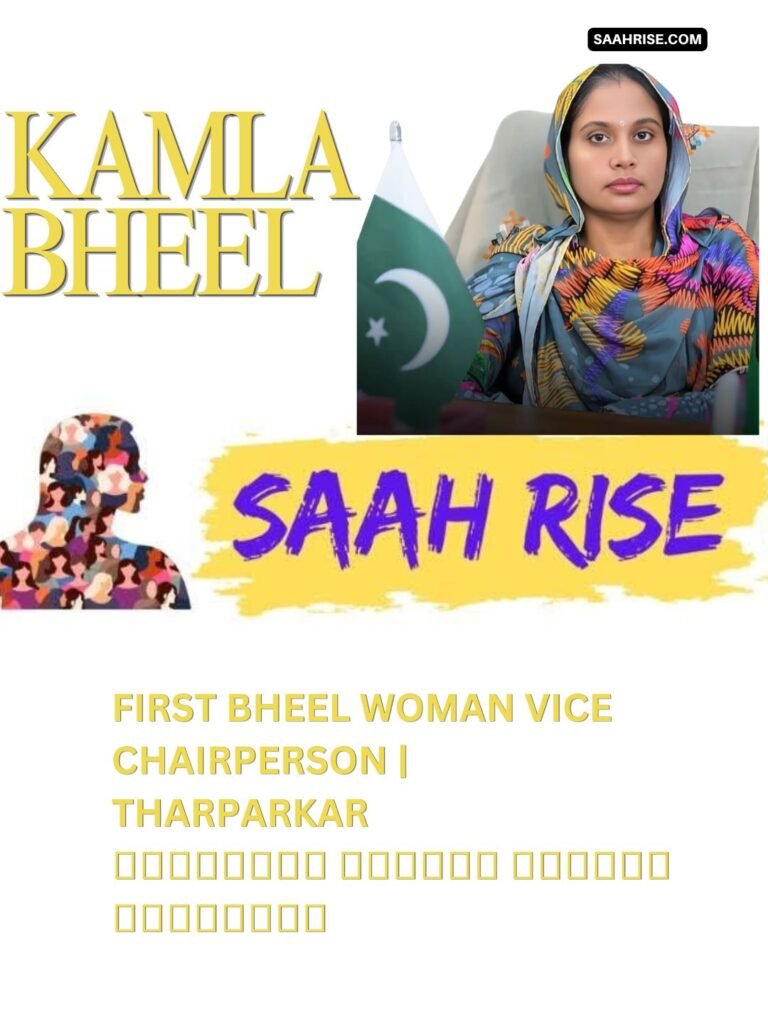
In the sun-scorched villages of Tharparkar, where sand dunes stretch further than opportunity ever did for women of the scheduled castes, Kamla Bheel decided that “no” was not an answer she would accept.
Today, she holds a title no woman before her ever held. But her story didn’t begin with power. It began with resistance inside her own home.
A Minority Within a Minority
Born into the Bheel community in Mithi, Tharparkar, Kamla belongs to a scheduled caste in a province where caste, gender, and poverty often collide to push women to the margins three times over.
Even before society pushed back, her own family did. The belief was simple and suffocating: daughters are meant for marriage, not classrooms. Kamla studied anyway, completing her education at Mithi Degree Girls College, a quiet act of defiance that would shape everything after it.
As she puts it herself:
“Women in my caste are a minority within a minority. Being a woman from a minority in politics means breaking barriers with every step and shattering glass ceilings that were never meant to be broken.”
Choosing Service Before Power
Kamla didn’t walk into politics looking for a title. She walked into her community looking for problems worth solving.
Starting in 2005, she became a Minority Rights Social Activist, working alongside respected development organizations TRDP, CRS, Thar Foundation, and CWS on the issues that define daily survival in Thar: education, water, healthcare, and livelihoods.
From 2016 to 2020, she served as a Member of District Council Tharparkar, using the seat not as a milestone but as a tool, a way to bring the concerns of women and minorities directly into rooms where decisions were made without them for generations.
Recognized on a National Stage
Kamla’s work did not go unnoticed. UN Women Pakistan featured her story as part of its effort to document women reshaping local governance, highlighting her as the first woman in Tharparkar’s history to become District Vice Chairperson, a role built on nine years of grassroots advocacy for girls’ education and community welfare.
It was recognition of something simple: change led by the people closest to the problem lasts the longest.
The First. Not the Last.
Kamla Bheel’s most defining achievement remains that she became the first woman from the Bheel community to serve as Vice Chairperson of the District Council, Tharparkar. Not the first woman in name only, but the first to hold real institutional power in a system that was never designed to include her.
She now serves as General Secretary of the PPP Women Wing, Mirpurkhas Division, continuing a mission she has carried for two decades: making sure marginalized voices, especially those of women from minority communities, are not just heard, but represented.
Why Her Story Matters
Kamla Bheel’s journey is a reminder that leadership doesn’t always arrive through privilege or proximity to power. Sometimes it’s built village by village, one act of quiet defiance at a time, a girl who stayed in school when she was told not to, a woman who ran for office when no one from her community ever had.
At SAAH RISE, we believe stories like Kamla’s deserve to be told not as exceptions, but as evidence of what’s possible when representation reaches the communities history forgot.
This piece is part of SAAH RISE’s Hidden Women Leaders series, documenting the stories of Pakistani women whose leadership rarely makes it into mainstream narratives.