
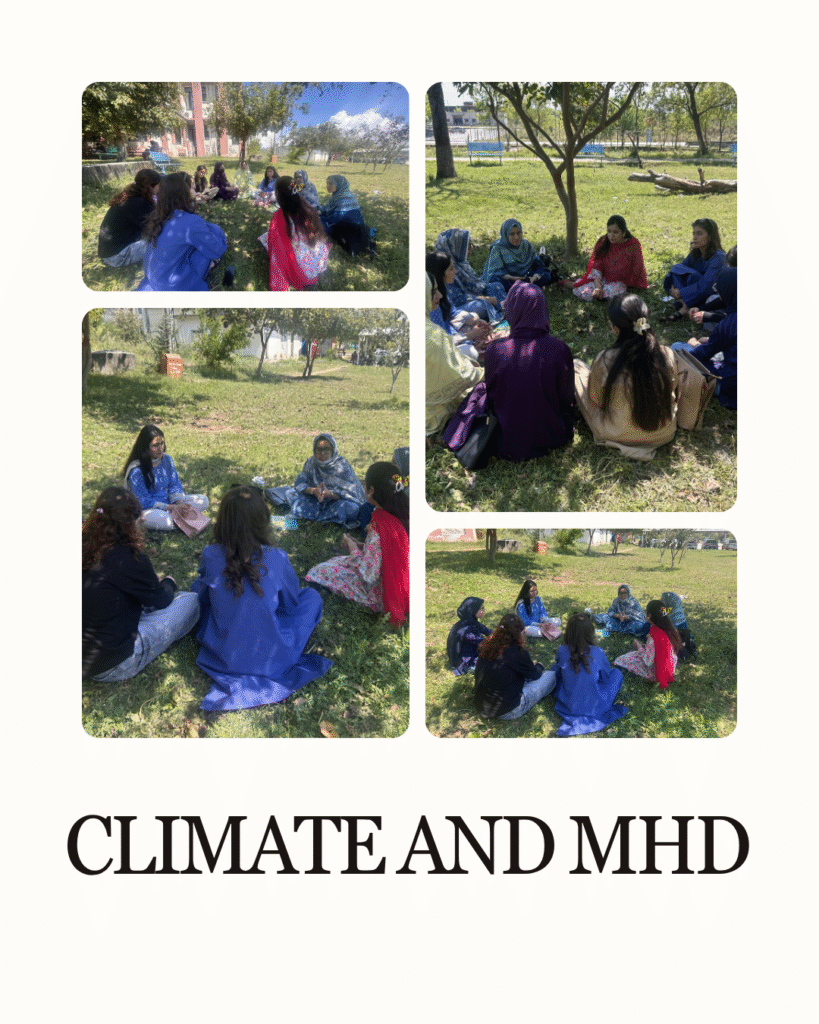
On 6th April, Team Saah Rise organized a thought-provoking session on Climate, Gender, and Menstrual Health & Dignity (MHD), facilitated by Dur-e-Najaf Zahra in a small and interactive circle setting. The session brought together students of Environmental Sciences from diverse regions of Pakistan to reflect on the intersections of climate change, gender, and menstrual health in local communities.
The discussion began with an open conversation on the myths, taboos, and cultural stigmas surrounding menstruation in different parts of the country. Participants from Sindh, South Punjab, Gilgit, Buner (KPK), and Central Punjab shared personal observations and lived experiences, highlighting how menstrual health is often shaped by regional traditions, access to resources, and social attitudes. The circle created a safe and respectful environment where participants felt encouraged to speak honestly and listen to one another’s perspectives.
As the session progressed, the conversation moved toward the relationship between climate change and gender inequality. Participants discussed how climate-related disasters such as floods, heatwaves, water scarcity, and displacement disproportionately affect marginalized communities, especially women and menstruating individuals. Limited access to sanitation, healthcare, menstrual products, and safe spaces during environmental crises was identified as a major concern that often remains overlooked in climate discussions and policy responses.
The session also emphasized the importance of adopting inclusive and gender-sensitive approaches in climate action. Participants reflected on the need for community awareness, accessible menstrual health education, and policies that recognize menstrual dignity as an essential part of public health and climate resilience. By connecting environmental issues with social justice, the discussion encouraged participants to think critically about how sustainable solutions must also address gendered experiences and inequalities.
Beyond academic discussion, the gathering fostered empathy, collective learning, and solidarity among participants from different cultural and geographical backgrounds. The exchange of stories and perspectives demonstrated how open dialogue can challenge silence and stigma while encouraging more informed and compassionate engagement with issues of climate and menstrual health.
This session was conducted in collaboration with Baithak’s South Asian Menstrual Health and Dignity Regional Institute, further strengthening efforts to promote awareness, dignity, and inclusive conversations around menstrual health in the context of climate justice.