
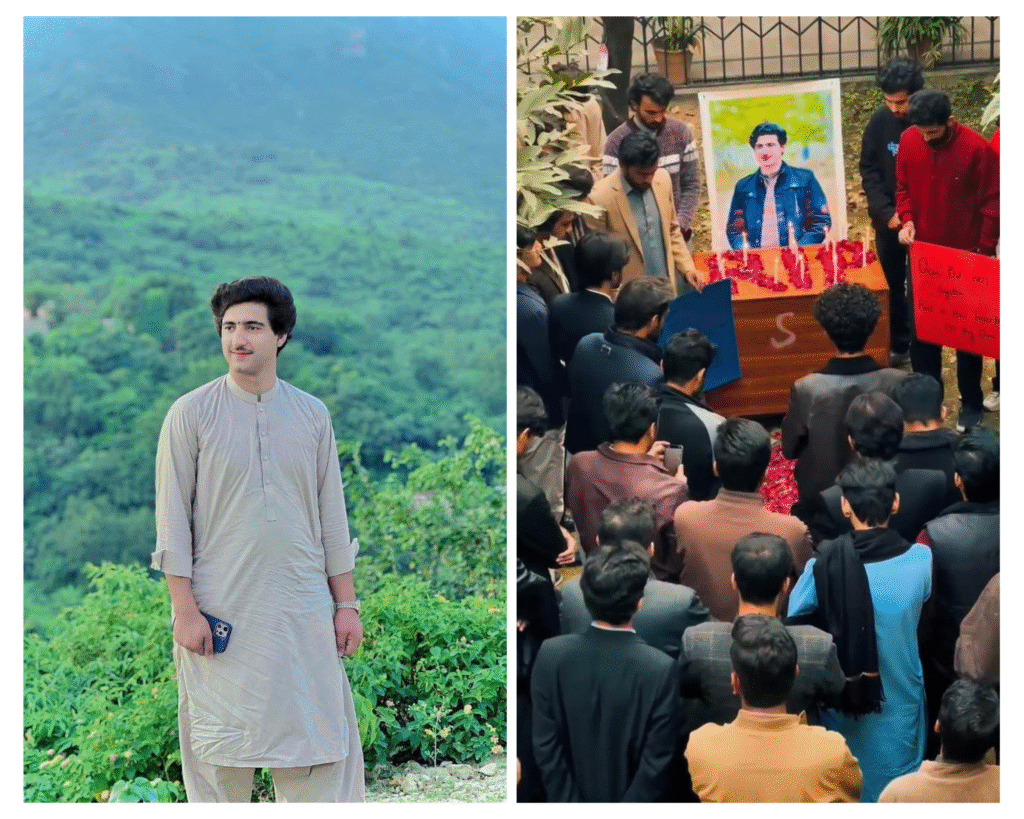
A few days ago, Irfan Ullah, a 5th semester Political Science student at Quaid-i-Azam University, was brutally murdered in his residence in Barakahu, Islamabad. Shockingly, this heinous act has received little to no media coverage, leaving a silence that raises serious concerns about whose lives are valued and whose are ignored.
Student Activism Amid Silence
The Quaid-i-Azam Student Federation (QSF) attempted to bring the matter to public attention through social media, while the Pakhtun Student Council arranged Ghaibana Namaz Janaza and peaceful protests to demand justice. These efforts highlight the courage of students, yet underscore the chilling reality: in the federal capital, even students’ lives are under threat.
This is not an isolated incident. Previous cases have shown students being targeted, with minimal accountability. Officials such as the Director of Student Affairs and representatives of the Pakhtun Council have publicly expressed satisfaction with ongoing police investigations, leaving questions about systemic apathy and justice unanswered.
Gender, Intersectionality, and Violence
Viewing this tragedy through a gender lens, it becomes evident that intersectionality plays a significant role. Irfan’s identity as a Pakhtun student in Islamabad intersects with broader social hierarchies, power dynamics, and systemic marginalization. Violence against marginalized student communities is often underreported, reflecting societal biases and structural inequities.
The lack of media attention, including national and local newspaper,s reveals a critical issue: whose stories are deemed newsworthy and whose are rendered invisible. From a gender and social justice perspective, this silencing reproduces power imbalances, leaving vulnerable communities unprotected and unheard.
The Failure of Collective Responsibility
As gender and social justice advocates, this incident forces us to confront uncomfortable truths:
- Are student movements and media outlets failing in their responsibility to speak out against violence?
- Is society, as a whole, complicit in normalizing these acts of violence by ignoring them?
The murder of Irfan Ullah is not just a crime, it is a wake-up call. It exposes how structural inequalities, intersectional marginalization, and societal apathy perpetuate cycles of violence. The absence of collective outrage and media scrutiny points to a deeper societal failure.
Moving Forward: Accountability and Awareness
To prevent such tragedies, multiple steps are essential:
- Media accountability: Journalists must cover incidents affecting marginalized student communities. Silence reinforces injustice.
- Institutional responsibility: Universities and student affairs authorities must prioritize student safety and address threats proactively.
- Intersectional advocacy: Activists, particularly from gender and social justice backgrounds, must highlight how identity markers like ethnicity, class, and gender shape vulnerability.
- Student mobilization: Student movements must persist in advocating for justice, refusing to allow violence to go unnoticed.
Conclusion
The murder of Irfan Ullah is a stark reminder that violence and injustice do not occur in a vacuum. They intersect with societal biases, systemic neglect, and institutional failure. By viewing this tragedy through a gendered and intersectional lens, we can better understand the roots of such violence and mobilize action to ensure that all students, regardless of ethnicity or background, can live safely and be heard.
It is time for society, media, and institutions to rise, to honor Irfan’s life by demanding justice, and to create an environment where student safety is non-negotiable.