
Reflective Report
Conducted by: Saah Rise
In Collaboration With: Centre of Excellence in Gender Studies (CEGS), Quaid-e-Azam University, Islamabad and Anthropology Club, Quaid-e-Azam University, Islamabad
Date: October 20, 2025
Duration: 2 hours
Venue: Gender Studies Department, Quaid-e-Azam University
-
Overview
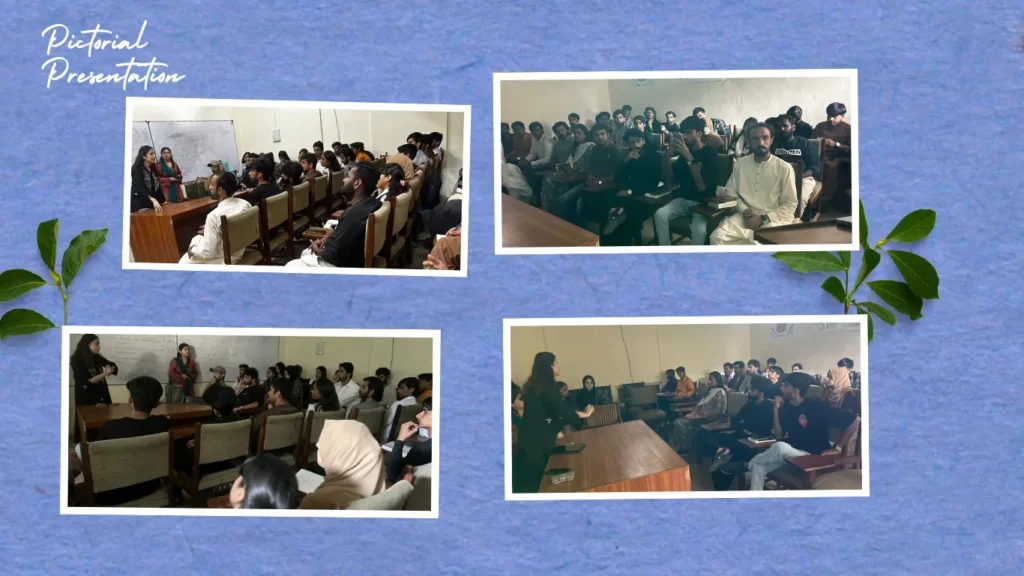
On October 20, 2025, Saah Rise, in collaboration with the Centre of Excellence in Gender Studies and the Anthropology Club at Quaid-e-Azam University, organized a two-hour Healing Circle titled “Her Right to Dignity: A Healing Circle on the Harassment Law 2022.”
The seminar aimed to build awareness of the Protection Against Harassment of Women at the Workplace (Amendment) Act 2022 while creating a reflective and empathetic space for participants to share their experiences. The event combined legal education, open dialogue, and creative expression to promote understanding and collective healing.
-
Background and Rationale
Harassment in professional and academic environments remains one of Pakistan’s most under-reported issues, largely due to fear, social stigma, and institutional silence. While the original 2010 Act introduced critical protection mechanisms, many marginalized groups including domestic workers, interns, and transpersons remained unprotected until the 2022 amendment.
Recognizing the urgent need to bridge the gap between legislation and lived reality, Saah Rise initiated this Healing Circle as part of its community engagement to foster awareness, empathy, and behavioural change among both men and women.
-
Objectives
- To raise awareness about the Harassment Law 2022 and its expanded protections.
- To provide a safe environment for dialogue and personal storytelling.
- To promote gender-inclusive education by involving male participants as allies.
- To explore healing as both a personal and collective process through empathy and creative expression.
-
Key Activities and Flow
- The session began with a brief welcome by facilitator Dur e Najaf (the founder of Saah Rise), who introduced the concept of Healing Circles, spaces built on confidentiality, respect, and active listening. Participants opened with one-word reflections on dignity, setting a tone of shared empathy.
- A screening of Asha Movement’s documentary followed, illustrating the decade-long struggle behind the formulation of the 2010 Act and celebrating the efforts of feminists such as Dr Fouzia Saeed. This visual history provided context for understanding the journey toward legal recognition of workplace harassment in Pakistan.
- The discussion then turned to the 2022 amendments, emphasizing their inclusion of domestic workers, transpersons, and interns, as well as the recognition of verbal, digital, and psychological harassment. Participant, representing students, researchers, and activists shared insights and personal experiences, identifying both progress and gaps in enforcement mechanisms.
- In the latter part of the circle, participants were invited to express their emotions through an informal art-based healing activity. The session concluded with a symbolic musical performance: one participant played the guitar and sang a song dedicated to survivors, closing the event with solidarity and hope.
-
Reflections and Insights
- The inclusion of both male and female participants significantly enriched the discussion. Men reflected on unintentional behaviours that could contribute to hostile environments, acknowledging the importance of self-education and accountability.
One male participant noted, “Today I learned that even a comment meant as a joke can deeply affect someone; I need to be more mindful.”
A female survivor shared, “My colleague harassed me at work, and I reported him because this law existed. Eventually, he was dismissed. Knowing this Act gave me strength to speak up.” - These reflections highlighted that awareness of legal frameworks can transform fear into empowerment and ignorance into empathy.
-
Learning and Challenges
Key learnings included:
- A stronger understanding of the Harassment Law 2022 and its institutional mechanisms.
- Recognition that healing requires collective participation, not solitary resilience.
- Realization that awareness among men is vital for cultural transformation.
Challenges discussed:
- Fear of retaliation remains a major deterrent to reporting.
- Lack of institutional trust discourages survivors.
- Many institutions still treat harassment complaints as “personal matters.”
The facilitator emphasized that feminist education and behavioural change must accompany legal reform to achieve genuine workplace safety.
-
Impact and Outcomes
The Healing Circle created an environment of trust, empathy, and solidarity, allowing participants to reflect deeply on personal experiences. It reinforced that education, dialogue, and art can serve as tools of healing and resistance.
Participants left the session with increased legal awareness, emotional resilience, and a shared commitment to advocate for safe, dignified workspaces. The initiative also strengthened Saah Rise’s ongoing collaboration with academic partners in promoting gender justice and inclusive social awareness.
-
Organizational Reflection
For Saah Rise, this collaboration with the Centre of Excellence in Gender Studies and the Anthropology Club marked a successful model of academic–community partnership. The seminar demonstrated how interdisciplinary engagement can amplify feminist advocacy and extend awareness to young scholars and practitioners.
The experience reaffirmed the organization’s belief that sustainable change begins through dialogue, empathy, and collective accountability. Moving forward, Saah Rise aims to replicate such Healing Circles in other universities and community spaces across Pakistan to continue nurturing understanding and behavioural transformation.
-
Conclusion
“Her Right to Dignity” served as more than an educational seminar, it was a moment of shared humanity where pain met purpose and awareness turned into empowerment. Through the collaboration between Saah Rise, CEGS, and the Anthropology Club, the event illustrated that legal reform and social change must evolve together. Healing, when approached collectively, becomes an act of both justice and hope.