
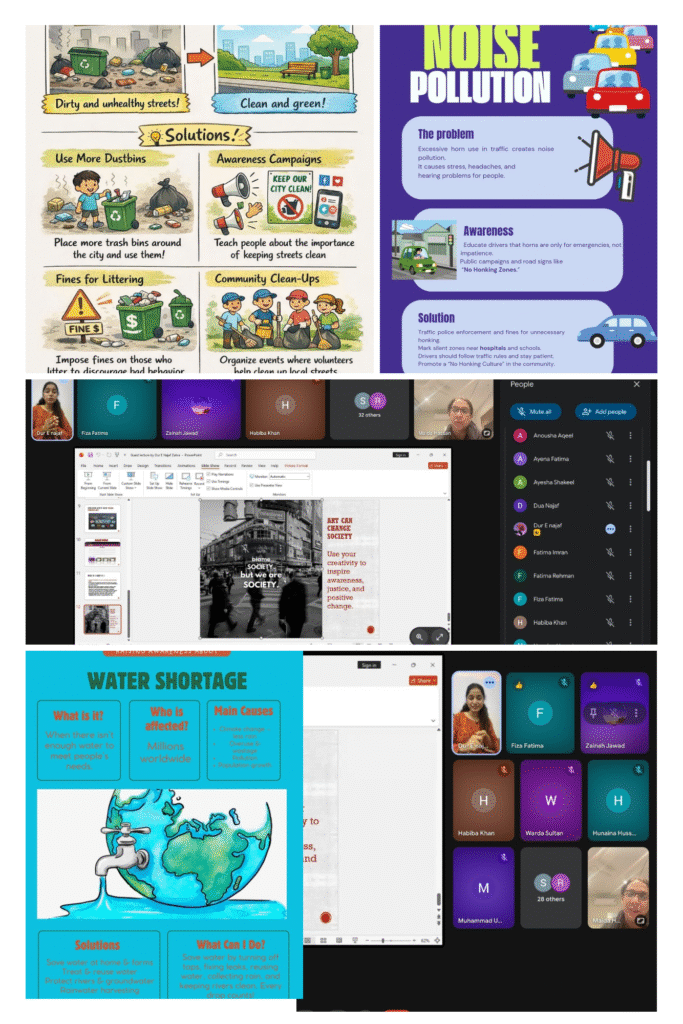
On 18 March 2026, Saah Rise contributed to academic engagement on civic responsibility and community development through a two-hour virtual guest lecture delivered by its founder, Dur E Najaf Zahra, to the students of the Visual Arts Department at Pakistan Institute of Fashion and Design, Lahore. The session was conducted via Google Meet as part of the undergraduate course “Community and Civic Engagement.”
The invitation was extended by Maida Hasan, Associate Professor, whose facilitation and continued support ensured a structured, interactive, and intellectually stimulating learning environment.
Situating Art within Civic Engagement
The lecture foregrounded the relationship between creative practice and civic responsibility, encouraging students to critically engage with their role as artists within broader social contexts. Drawing upon her academic background in Gender Studies and practical experience in community engagement, Dur E Najaf Zahra articulated citizenship as an active and participatory process, rather than a passive legal status.
The session examined key conceptual areas, including:
-
Human rights and civic duties
-
Youth participation in community development
-
Art as a medium of social awareness and resistance
-
The ethical and strategic use of digital platforms for civic engagement
Particular emphasis was placed on the role of social media platforms such as Instagram and Facebook as contemporary tools for digital activism and visual communication. Students were encouraged to critically assess how these platforms can be mobilized to disseminate information, shape public discourse, and amplify marginalized voices.
Experiential Learning through Infographic Design
To translate theoretical insights into practical application, the session incorporated an interactive activity centered on infographic design for social awareness. The class was organized into three groups, each consisting of six students, to encourage collaborative engagement and collective problem-solving.
Each group was tasked with developing a conceptual infographic addressing pressing community issues, including:
-
Water shortage
-
Noise pollution
-
Child labor
-
Garbage accumulation in public spaces
Students were required to integrate key informational elements—such as concise messaging, relevant data points, visual symbols, and actionable solutions—into coherent and accessible visual formats. The exercise highlighted the capacity of infographic design to simplify complex social realities and communicate them effectively to diverse audiences, particularly within digital environments.
Engagement in a Virtual Learning Context
Despite the constraints often associated with online instruction, the session demonstrated a high level of student engagement and participation. The interactive format enabled students to actively contribute, exchange ideas, and reflect critically on the intersection of art and society.
Their responses indicated a strong awareness of contemporary social challenges, as well as the ability to conceptualize creative interventions that extend beyond aesthetic considerations. The session thus underscored the potential of virtual platforms to facilitate meaningful and participatory learning experiences.
Institutional Facilitation and Pedagogical Significance
The effectiveness of the session was significantly enhanced by the role of Maida Hasan, whose initiative to incorporate external practitioners into the academic setting reflects a broader pedagogical commitment to bridging theory and practice. Such engagements contribute to a more holistic educational experience, enabling students to contextualize their academic knowledge within real-world frameworks of social action.
Concluding Reflections
The lecture concluded with a critical reflection on individual and collective responsibility in shaping societal structures:
“We often attribute societal shortcomings to external forces; however, it is essential to recognize that we ourselves constitute society. Meaningful change begins with individual awareness and action. As artists, your creative practice holds the potential to transform social realities—utilize it to foster awareness and promote change.”
This statement encapsulated the central premise of the session: that artistic practice, when informed by social consciousness and ethical responsibility, can function as a powerful instrument of transformation.
Towards Creative Citizenship
This engagement reflects Saah Rise’s ongoing commitment to fostering creative citizenship, wherein young individuals are encouraged to integrate artistic expression with civic awareness and social responsibility. Collaborations with institutions such as Pakistan Institute of Fashion and Design serve as important platforms for cultivating dialogue, critical thinking, and community-oriented practice among emerging artists.
Through such initiatives, Saah Rise aims to contribute to the development of a generation that is not only creatively skilled but also socially conscious and actively engaged in shaping a more equitable and informed society.