
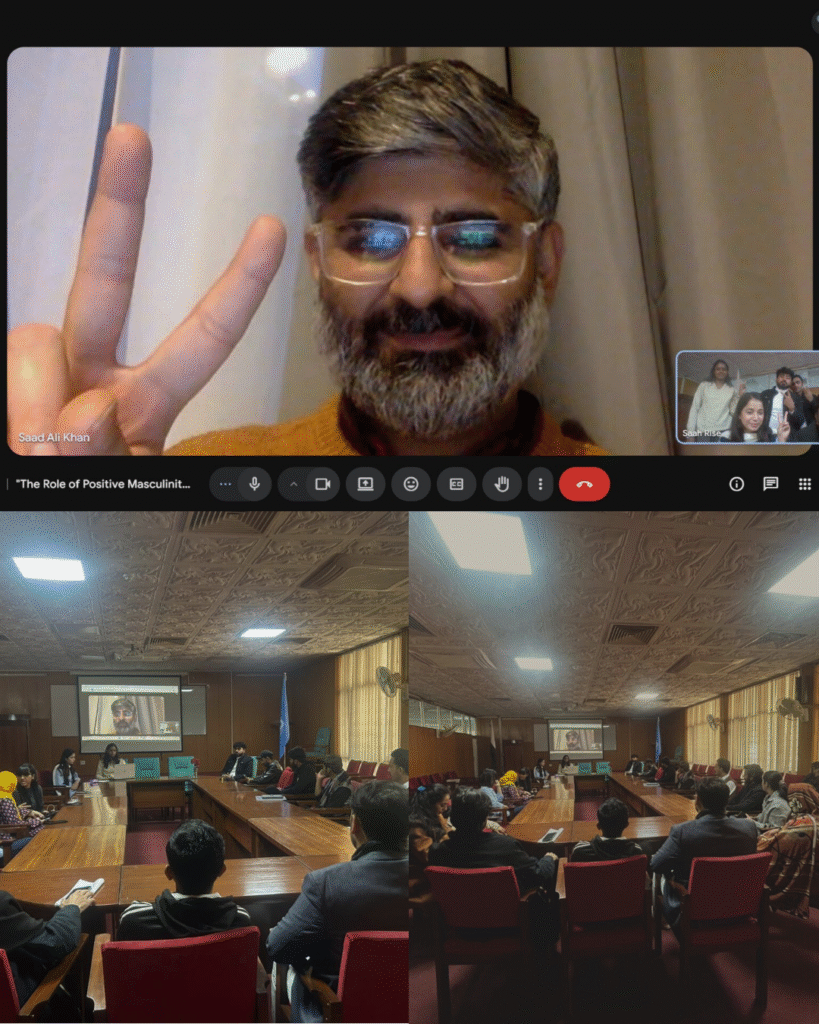
On 19 December, Team Saah Rise, in collaboration with the Quaidian Finance Society, organized an engaging and intellectually enriching session on “The Role of Positive Masculinity”. The session was facilitated by Dr. Saad Ali Khan, Assistant Professor at the Centre of Excellence in Gender Studies (CEGS) and currently a Postdoctoral Fellow at The Hague.
The session aimed to foster critical dialogue on gender, masculinity, and social justice, and it successfully attracted students from diverse academic departments, making the discussion multidisciplinary and inclusive.
Dr. Saad Ali Khan began by laying a conceptual foundation, introducing gender as a social construct and clarifying common misconceptions around feminism. He emphasized that feminism is not a movement against men, but rather a struggle for equity, justice, and shared responsibility. Central to his talk was the concept of positive masculinity, highlighting how men can actively contribute to dismantling patriarchal norms rather than reinforcing them.
A significant portion of the discussion focused on the historical marginalization of women and transgender communities, and how these groups are now collectively asserting their rights. Dr. Khan stressed that gender justice is not a zero-sum game; it is neither men versus women nor women versus men. Instead, it is a collaborative process where one gender supports and uplifts the other, fostering a more just and humane society.
The session was highly interactive, marked by thoughtful questions from students. Key discussions included:
- The rural–urban divide in understanding and practicing positive masculinity
- A critical question from an MBA student on men’s control over financial decision-making
- Concerns regarding gender education, where individuals—particularly women—are labeled as “badtameez” or “ziddi” for demanding their rights
- Questions on the relationship between religion and gender justice
Responding to religious concerns, Dr. Khan offered a nuanced and insightful perspective grounded in Islamic history. He referenced the lives of Hazrat Khadija (RA), Hazrat Fatima (RA), and Hazrat Aisha (RA) as powerful examples of women’s agency, leadership, and intellectual authority in Islam, reinforcing that gender justice is deeply rooted within religious teachings rather than being opposed to them.
The session spanned 2.5 hours, with 1.5 hours dedicated to the speaker’s lecture and 1 hour for an extensive question-and-answer segment. Students actively engaged throughout, reflecting a strong interest in understanding gender dynamics beyond surface-level narratives.
Overall, the session served as a meaningful academic and social intervention, encouraging students to critically reflect on masculinity, privilege, and responsibility. By framing gender justice as a collective endeavor, the event reinforced Saah Rise’s commitment to promoting inclusive dialogue, critical thinking, and transformative social change.
#saahrise #positivemasculanity #genderstudies #seminar