
Conducted by: Saah Rise
In collaboration with: Climate Class Connection
Date: 2nd November, 2025
Venue: Quaid e Azam University, Islamabad
Introduction
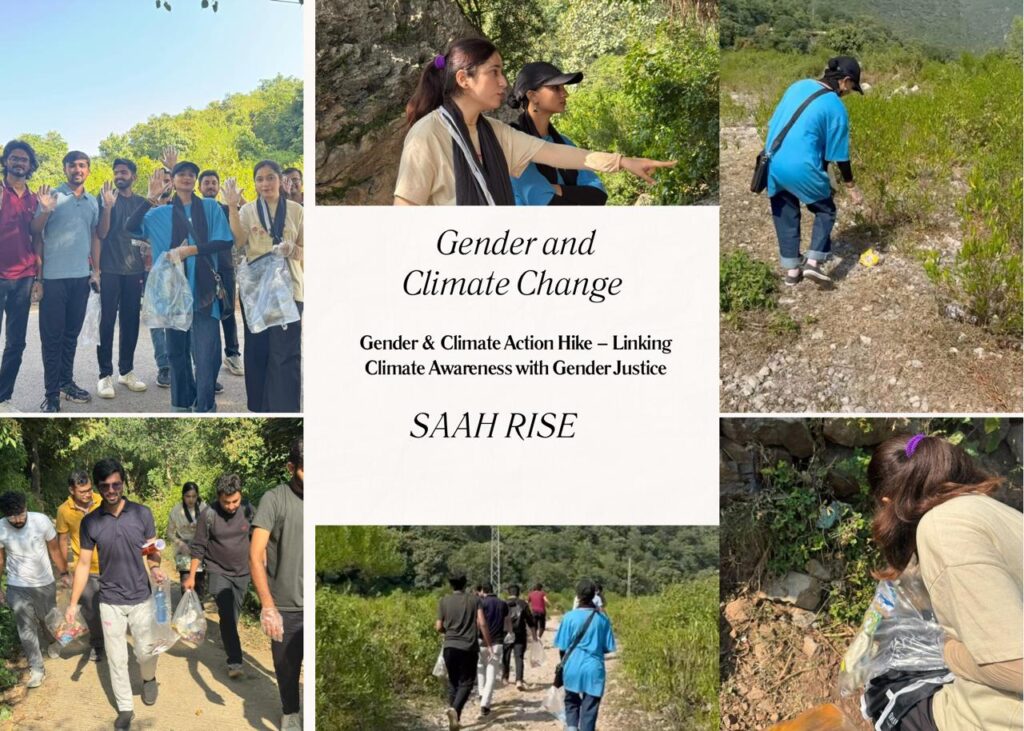
On 2nd November 2025, Saah Rise, in collaboration with Climate Class Connection, organized a Gender & Climate Action Hike aimed at linking environmental consciousness with gender justice. Students from Quaid-e-Azam University (QAU) and National Defence University (NDU) joined the activity, bringing together diverse perspectives, regional insights, and a shared commitment to climate-focused civic engagement.
The event combined physical activity, environmental responsibility, and participatory learning. It provided students not only with an experiential understanding of climate challenges but also with space to reflect on the interconnected gendered dimensions of these crises.
Environmental Action During the Hike
The hike began with an on-ground environmental stewardship activity where participants cleared the trail and collected trash along the way. This simple but impactful action symbolized the essence of community-driven environmental responsibility. It also set the tone for the rest of the event: climate action is not only large-scale advocacy but also the accumulation of small, consistent, local initiatives that build collective change.
Learning Sessions at the Summit Point
At the top of the trail, the group engaged in three insightful learning sessions facilitated by subject experts:
- Climate Justice and Gender – Facilitated by Warda, Advocacy Manager at Climate Class Connection
This session highlighted how climate injustice disproportionately affects marginalised communities, especially women. Warda emphasised structural inequalities, labour burdens, and the gendered impacts of climate disasters. - Gender and Climate Change – Facilitated by Dur-e-Najaf, Founder of Saah Rise
Dur-e-Najaf explored how gender intersects with ecological stressors, discussing unequal access to resources, women’s role in caregiving, and the need for inclusive climate adaptation strategies. - Youth Action for Gender & Climate Solutions – Facilitated by Nauman Alam, Founder of Climate Class Connection
This session encouraged young participants to see themselves as catalysts of change. Nauman discussed youth-led innovation, climate advocacy, and the power of collective mobilization in transforming local challenges.
Insights from Participants: Local Gender Issues Worsened by Climate Change
The interactive segment allowed participants from diverse districts to share real-life issues from their communities. These conversations showcased the lived intersection of gender and climate realities across Pakistan.
Key issues and youth-led solutions included:
- Kasur & Rohri
Issue: Lack of safe transportation and electricity restricts women’s access to education and employment.
Youth Solution: Advocate for clean energy initiatives and gender-responsive mobility systems. - Jacobabad & Muzaffargarh
Issue: Intense heat stress and recurrent flooding strain women’s health and caregiving roles.
Youth Solution: Develop cooling shelters and community-based health awareness programs. - Umerkot
Issue: Crop failures increase child marriages; digital divide limits girls’ learning opportunities.
Youth Solution: Integrate girls’ education and digital literacy into climate adaptation programs. - Peshawar & Ghotki
Issue: Pollution and inadequate sewage systems disproportionately affect women’s health.
Youth Solution: Campaign for improved industrial regulation and sanitation facilities. - Bannu
Issue: Loss of ponds and Godder (traditional women’s gathering spaces) deepens women’s social isolation.
Youth Solution: Revive communal, eco-friendly spaces that support both women’s wellbeing and local ecology.
Collaborative Activity: “Solution Trees”
Each mixed group created a “solution tree”, using the tree as a metaphor for how ideas grow roots, branches, and fruit. This symbolic activity encouraged participants to visualize how local solutions, when nurtured, can evolve into impactful movements. These trees reflected hope, creativity, and the transformative potential of youth when provided a platform.
Reflections
This event demonstrated that climate action cannot be separated from gender justice. The discussions made it clear that climate vulnerabilities often magnify existing gender inequalities, especially in rural and marginalized communities. Yet, the energy and insight from students showed that young people are ready to respond with innovative, context-sensitive solutions.
The hike also reinforced the importance of experiential learning. Walking together, cleaning the trail, sharing stories, and engaging in critical discussion created a sense of community and responsibility that a classroom setting alone cannot provide.
For Saah Rise and Climate Class Connection, this collaboration reaffirmed the power of youth engagement, intersectional learning, and community-driven climate advocacy. The event successfully strengthened networks between institutions and empowered participants to think critically about their role in shaping equitable climate futures.
Conclusion
The Gender & Climate Action Hike was more than an environmental activity, it became a platform for dialogue, reflection, and collective imagination. It highlighted the urgent need for gender-responsive climate solutions and showcased the readiness of young people to lead these transformations. Through small steps like cleaning a trail and large conversations like envisioning community-based climate justice, the event embodied the spirit of sustainable, inclusive activism.